Average Wedding Cost in Sydney vs Melbourne vs Brisbane in 2024
Sydney and Melbourne cost more than Brisbane, driven mainly by venue prices and guest-count norms.

The national average wedding cost in the country is around $38,000, but that number hides more than it reveals. Sydney, Melbourne, and Brisbane each have their own cost profile, shaped by venue pricing, guest-count norms, and vendor markets that don't behave the same way from city to city. A couple marrying in inner Sydney and a couple marrying in regional Queensland aren't playing the same game, financially speaking, even if a survey lumps them into one average.
Other surveys land in similar territory but with real spread: at least one source puts the average closer to $37,000, and ranges extending well above and below that midpoint appear across the research. That spread isn't noise. It's the whole story compressed into one range, and unpacking it by city is what actually helps a couple set a number they can trust.
How the three cities stack up at the total-spend level
Sydney runs highest. Survey data for one state puts average wedding spend in the high thirty-thousands to low forty-thousands, and separate industry research on that state's major metro area specifically lands a bit higher still. Melbourne is just under that: Victoria's average spend falls a little below that range in survey data, while research focused on Melbourne itself puts the city somewhat higher again, citing strong demand for venues and a crowded, competitive supplier market as the reason prices hold firm.
Brisbane is where the real gap opens up. Queensland's average spend, per survey data, comes in noticeably lower than New South Wales and Victoria, with other research citing a wider band for a full-scale Queensland wedding. That's a difference of ten to fifteen thousand dollars against Sydney, sometimes more.
Treat all of these as ranges, not targets. The same total budget can produce very different weddings depending on what a couple decides matters most. And the metro area itself isn't one price tag: the surrounding regional part of that state tends to run 20 to 30% lower than the metro area, which means the city name on its own tells you less than you'd think. The ranges are one thing. What's actually driving them is another question entirely, and it starts with the venue.
Venue pricing is the single biggest lever, and it moves differently in each city
Venue is the single largest cost in an Australian wedding budget, full stop. Nationally it averages a substantial five-figure sum, and couples put close to half their entire budget, about 46%, into the reception venue alone. Nothing else in the budget carries that kind of weight, so it's the right place to start explaining the gap between cities.
Victoria posts the highest average venue cost in the country, comfortably into five figures. That state comes in a little behind that, at a similar though somewhat lower level. Queensland's average venue cost is meaningfully lower, well behind the other states, and that gap alone accounts for a large chunk of the difference between a Brisbane wedding and a Sydney one. For comparison, the remaining states sit fairly close together in the middle of the pack, giving couples a sense of where the rest of the country falls.
Rural and regional venues tend to run $2,000 to $3,000 cheaper than their city equivalents, which is a real and fairly consistent discount, not a rounding error. On a per-guest basis, venue hire alone averages around $170 a head, which is a useful number for scaling a guest list up or down.
The Victoria figure is a little counterintuitive. Melbourne has the highest average venue cost in the country, yet its total wedding spend lands below Sydney's. That suggests Melbourne couples are putting proportionally more of their budget into the venue relative to everything else, or that Melbourne's venue market is priced consistently high across the board with less room at the bottom end. Either way, venue explains a lot of the structural gap between these cities. But it doesn't explain all of it. Guest count is doing quiet work underneath the surface.
Guest count norms differ sharply by city and quietly drive the rest of the budget
Weddings in that state average around 121 guests. Queensland weddings average around 74. That's a gap of nearly fifty people, and it doesn't stay contained to one line item, it cascades through catering, venue capacity, favors, invitations, and every other per-head cost in the budget.
Most Australian couples spend somewhere between $150 and $250 per guest across the whole event. Run that math against the 47-guest gap between that state and the other state, and a good portion of the total-spend difference between the two cities stops looking like a big-city tax and starts looking like arithmetic. Victoria doesn't have a clean, specific guest-count figure in the data, but its guest lists appear to be in a mid-to-large range, consistent with its higher total spend relative to Queensland.
A couple marrying in Brisbane isn't necessarily choosing the cheaper wedding. They may just be marrying in a city where a smaller guest list is the norm, and that alone compresses the budget before a single vendor gets booked. Before comparing city price tags against each other, a couple's own guest count is the first real variable they control, and it's worth locking down before anything else.
What the money actually goes to: a category-by-category picture
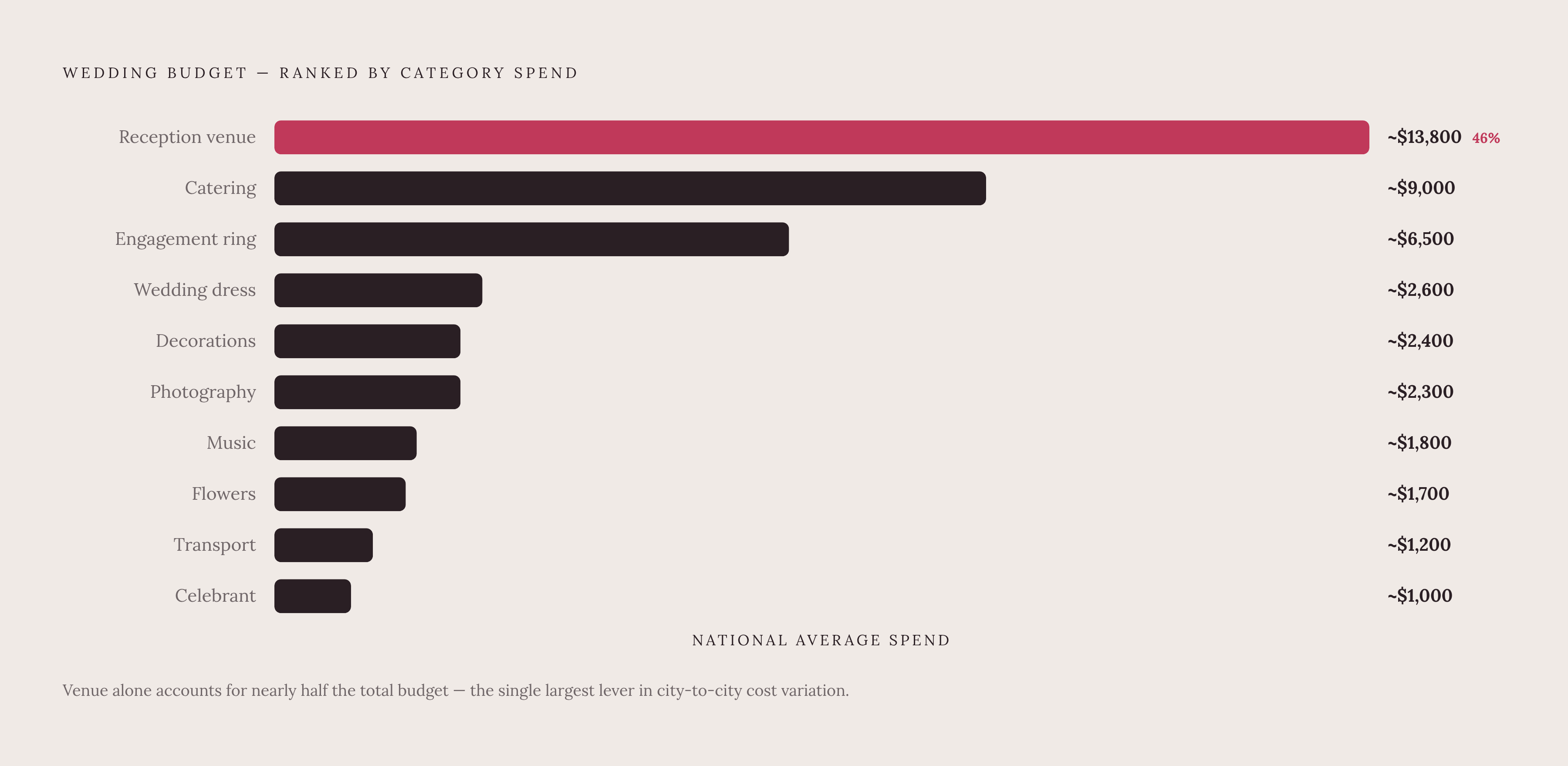
Catering is one of the largest line items, averaging just under five figures nationally and up 2% from the prior year. It's also the cost most directly tied to guest count, so it moves fastest when the list grows or shrinks. Photography averages a few thousand dollars, and 90% of couples hire a professional, the highest adoption rate of any wedding service in the budget.
Flowers average a couple of thousand dollars, though that number swings widely depending on the style and volume a couple wants. Decorations cost a bit more than flowers, again with heavy variance depending on how elaborate the vision is. Music averages a couple of thousand dollars. The wedding dress averages a similar amount to decorations: three-quarters of brides buy new, 15% go custom, and 42% budget for at least one outfit change during the day. Celebrants average around a thousand dollars, and transport costs a little more than that. The engagement ring, which isn't technically part of the wedding budget but eats into the same household finances, averages roughly two and a half times the cost of the wedding dress, up 14.5% compared to previous data.
Here's the honest picture: most of these categories don't move much by city. Photography, celebrant fees, and music are at broadly similar price points whether the wedding is in Sydney, Melbourne, or Brisbane. The city premium concentrates almost entirely in venue, and to a lesser extent, catering. Everything else is closer to a flat national market. These are averages, though, and averages assume a couple sticks to the plan. Most don't.
Why couples end up spending more than they planned, and where the overrun happens
Couples typically start planning with a budget well under what they end up spending. The national average that ends up getting spent runs noticeably higher than that starting budget. Sit those two numbers side by side and the overspend is visible before anyone even mentions a percentage: it works out to couples spending roughly 23% more than what they originally set out to spend.
Part of the reason that gap exists is that most weddings aren't funded by the couple alone. Around 69% of couples receive some financial contribution from family, and that changes how a budget gets set in the first place, and how it gets revised later when plans shift.
The hidden costs tend to repeat across weddings regardless of city: vendor meals, wet-weather contingency like marquee hire, marriage license and permit fees, attire alterations, and transport logistics that weren't priced in at the quote stage. Alterations alone can push a dress budget up by a noticeable margin once fittings start. In Sydney and Melbourne specifically, where venue costs run highest and popular venues get booked out 12 to 18 months ahead, the timing makes this worse. A couple who underestimates their budget at the booking stage has very little room to correct course later, because the deposit is down and the date is locked.
A sensible buffer set aside for the unexpected costs that show up regardless of how carefully the plan was built is worth building in from the start. Having the family-contribution conversation early, before venue deposits go down, prevents a lot of the friction that shows up later. Knowing where the overspend tends to happen is useful. Building a budget that survives it is the actual task.
Building a city-realistic budget: what to anchor, what to flex, and how to track it
Book the venue first. It sets the date, anchors the guest count, and turns every other vendor quote from a guess into a real number. This matters most in the two biggest cities, where the venues couples actually want tend to book out 12 to 18 months in advance, especially for the stretch of the year that both cities treat as peak season.
Once the guest list is set, work backwards from it. The $150 to $250 per-guest range gives a catering floor, and the roughly $170 per-head venue average gives a separate, second anchor. Between the two, a couple can build a number that's grounded in their actual list, not a citywide average.
Some categories barely move regardless of where the wedding happens: celebrant fees, photography (at 90% adoption, effectively a given for most couples), and music. Others swing hard depending on city and taste: venue, catering, flowers, and styling. Season plays a role too. Spring and autumn are peak everywhere, and winter dates tend to open up both pricing and availability, so it's a factor to model seriously if the date itself isn't fixed.
Tracking the number matters just as much as setting it. A budget entered once into a spreadsheet after an enquiry email, then never touched again, is exactly how that 23% overspend accumulates. A free budget planner through Moneysmart, the government's financial guidance site, is a reasonable place to start if a couple needs a structure to track against.
None of this is about spending less for its own sake. It's about spending on purpose, with a number that reflects the actual city, the actual guest list, and the actual priorities of the two people paying for it.
Sources
- How Much Does the Average Wedding Cost in Australia 2024?
- Wedding Cost in Australia | Complete Guide (2026)
- How much does a wedding cost in Australia in 2026
- How Much Does an Average Wedding Cost in Australia? - Canstar
- How Much Does a Wedding Cost in Australia in 2026?
- How Much Does a Wedding Cost in Australia? -
- qreport.com.au
- weddingscapturedbypeta.com.au