Gluten-Free Wedding Menus and the Cross-Contamination Liability Gap
Australian food law makes "gluten-free" a binding legal claim, not a kitchen preference.

A caterer writing "gluten-free" on a wedding menu isn't describing a flavor profile or a nice-to-have. Under Australian food standards (FSANZ), that phrase is a legal claim, and it demands no detectable gluten in the food. Most couples treat it like a box to tick on a form. Treat it instead like a contract term, because that's what it becomes the moment a plate hits the table.
FSANZ skips the numeric threshold other countries lean on. No parts-per-million cutoff, no "trace amounts under X are fine." Just: no detectable gluten. That's stricter than jurisdictions that allow a specific ppm allowance, and it leaves no built-in room for "close enough."
Oats are the trap most couples walk straight into. FSANZ doesn't count oats as gluten-free, even though some overseas jurisdictions apply different rules to oats under their gluten-free labelling frameworks. A couple who spots "oat" near a dish labeled gluten-free and assumes it's fine, because that's how it worked at a wedding overseas, is reading from the wrong rulebook.
This isn't pedantry. A caterer who puts "gluten-free" on a canape platter has made a binding claim under Australian law the moment that food goes out. The real exposure is in the gap between what the standard demands on paper and what happens in a working kitchen on a Saturday, with over a hundred covers going out in ninety minutes. That gap is where a couple's liability lives, whether anyone's thought about it or not.
Where cross-contamination enters a wedding catering operation
Cross-contact isn't a kitchen-floor problem alone. It can enter at any link in the chain: sourcing, transport, storage, prep, cooking, service. A caterer can run four of those five links cleanly and still lose the fifth, and that's usually all it takes.
Shared ovens are the least obvious offender. Convection ovens circulate hot air, and that air carries flour dust from whatever else is baking alongside. A gluten-free tart sitting two racks below a tray of dinner rolls picks up flour it never physically touched. Almost nobody thinks to ask about oven setup, because the risk stays invisible until someone actually walks you through the mechanism.
Equipment tells the same story. Wooden cutting boards and utensils are porous. Once flour works into the grain, no wash cycle pulls it back out. A "cleaned" wooden spoon that's spent three years handling regular pasta dough isn't clean under the FSANZ standard, no matter how it looks under kitchen lights.
Clinical research backs up why these small procedural gaps translate into real harm. A scoping review published in ScienceDirect looked at celiac patients strictly following a gluten-free diet and found that cross-contact remained a measurable concern even under careful adherence. Clinically relevant gluten levels were found to be rare but present in tested samples, a finding that sounds reassuring until you scale it across a full wedding season of shared kitchens, rented ovens, and staff working a double on four hours' sleep. The review even raised the question of whether strict avoidance of all cross-contact could be reconsidered, which is a conversation for clinicians to have. For a couple planning one specific Saturday, the takeaway is simpler: a well-run kitchen with good intentions can still produce contact that matters.
The questions to ask a caterer before you look at a single menu item
One question decides everything else, and it needs to get asked before a couple falls for a single degustation photo: is this a dedicated gluten-free facility, or does gluten-containing food get made in the same space?
If there's a celiac guest on the list and the kitchen is shared, that conversation is effectively over already. Good food photography doesn't fix a shared prep surface.
Say the kitchen clears that first bar, or the caterer can explain how it manages shared space well. These follow-ups separate real protocol from good intentions. Do staff change gloves and swap utensils between allergen-restricted plates and standard ones? Are gluten-free dishes prepped separately and ahead of anything that could contaminate surfaces? Can the caterer produce written allergen protocols and staff training records, rather than just describing them out loud? Does the kitchen carry third-party certification, such as GFFP, which certifies to 5 ppm, four times stricter than the FDA's 20 ppm threshold? And how does food actually travel from kitchen to venue: sealed, labelled containers, or open trays picking up airborne flour on the drive over?
Watch for answers that sound warm but carry no weight. "We can do gluten-free on request" isn't a protocol, it's a shrug with good manners. No written allergen plan, no certification, no training record on file: that combination is a red flag no matter how reassuring the tone in the room.
The "fully gluten-free by default" menu strategy and the risk equation
Some caterers skip the whole vetting exercise by solving the problem at the design stage instead of the execution stage. Building a menu where every dish is naturally gluten-free means there's no gluten in the building left to contaminate anything. That's risk removal, not risk management, and it's the stronger approach whenever the guest list can support it. Couples debating this should stop treating it as a style preference: if the guest list has even one celiac guest, full-menu removal beats vetting a shared kitchen every time.
The upside runs past safety, too. A celiac guest eats the identical plate as everyone else at the table. No separate station, no substitution arriving five minutes late with an apologetic look, no visible marker singling someone out over dinner. At a wedding, where nobody wants a guest flagged in front of the table, that detail carries more weight than it seems to on paper.
Buffets show the contrast most sharply. A shared-menu buffet always risks a guest dragging the same serving spoon from the bread basket into the rice. A fully gluten-free buffet removes that risk structurally, because there's no gluten-containing dish on the table to cross into anything.
None of this forces a boring menu. Rice-based dishes, naturally grain-free preparations, vegetable-forward courses built around technique rather than substitution: chefs turn out genuinely celebratory food inside this constraint constantly. Treat the restriction as the design brief, not the limitation.
Collecting dietary requirements before the caterer asks for them
The caterer asks for final meal counts two weeks out, and only then does anyone realize nobody collected dietary information from guests in any organized way. A round of last-minute texts goes out. Half get answered. The data that comes back is patchy, and on the day, a guest with a genuine allergy sits down in front of a plate they can't touch.
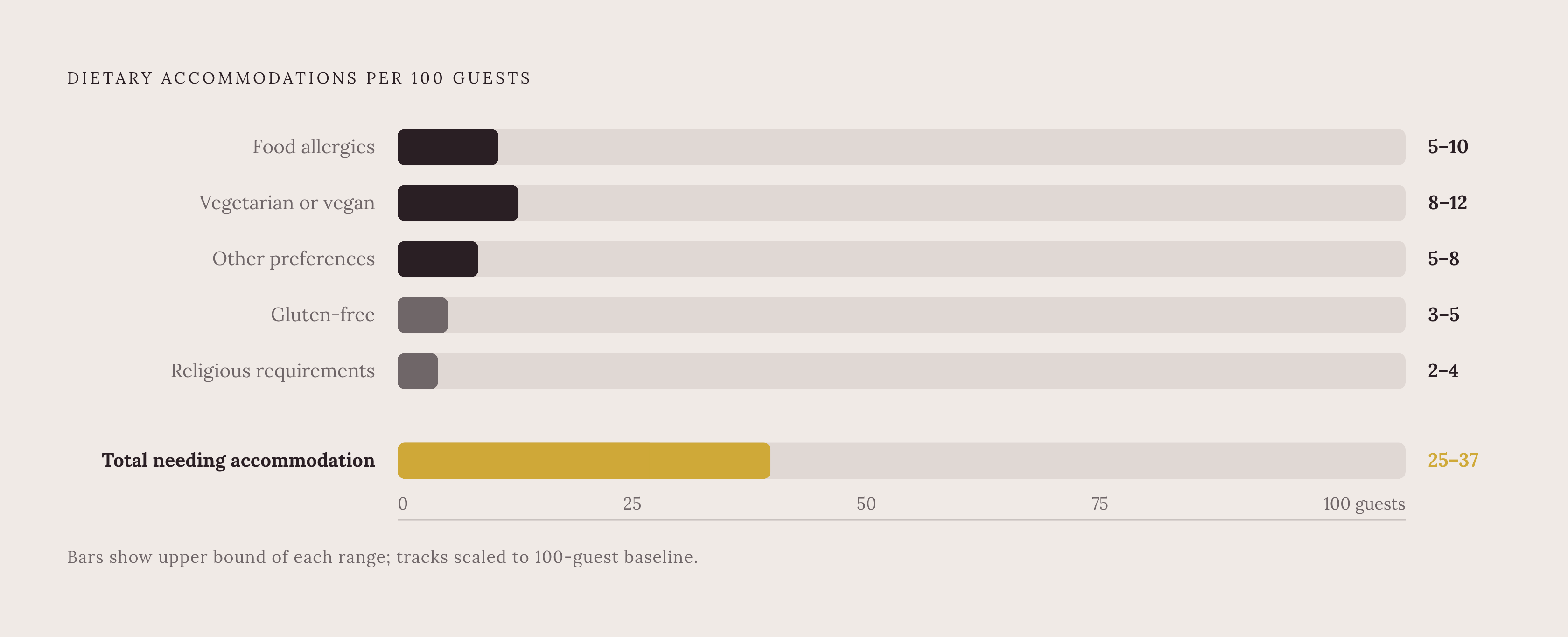
At a wedding-sized event of roughly 100 guests, expect something like 5 to 10 with food allergies, 8 to 12 who are vegetarian or vegan, 3 to 5 needing gluten-free meals, 2 to 4 with religious dietary requirements, and another 5 to 8 with other preferences layered on top. That adds up to somewhere between a quarter and a third of the guest list needing some kind of accommodation. Treat that as the planning baseline.
Timing fixes most of the chaos before it starts. RSVP forms should go out three to four weeks before the wedding with a dietary field marked required, not optional, because an optional field gets skipped by exactly the guests who most need to fill it in. The full dietary breakdown needs to reach the caterer in writing 14 days out. And there needs to be an explicit change-freeze date, agreed with the caterer in advance, past which the list is locked and nobody's adding a new allergy the Thursday before.
Sort responses into four buckets so the caterer can plan kitchen workflow, not just menu wording: allergen-based (gluten, nuts, shellfish), lifestyle-based (vegan, vegetarian), medical (celiac, diabetic), and no restriction. Medical and allergen categories need dedicated prep, no exceptions. Lifestyle categories can usually share a base dish with modifications. A kitchen that's organized assigns dedicated prep to medical cases from the start; a kitchen that's guessing finds out it needed to on the day, which is too late.
Connecting dietary data to the seating chart so nothing is lost on the day
Collecting the data is half the job. Getting that data in front of the person plating food on the wedding day matters just as much, and it's where a lot of otherwise careful planning quietly falls apart.
When dietary data and the seating chart are built as separate exercises in separate documents, there is no guarantee anyone connects them before the day itself. Without that link, service staff have no way of knowing which guest at a given table has a medical requirement and which simply has a preference. Both get treated the same, and one of them absolutely shouldn't be.
Every guest record on a seating chart needs, at minimum: name, table number, RSVP status, dietary category, and severity, meaning whether it's a preference or a medical requirement. That severity field changes everything downstream. A caterer handles "prefers no dairy" completely differently from "anaphylactic to shellfish," and the seating data has to preserve that distinction instead of flattening both into one generic dietary note.
A timeline that stays current, rather than going stale two weeks before the wedding, looks something like this: 6 to 8 weeks out, lock the preliminary floor plan, table count, and configuration. 4 weeks out, pull in guest list and dietary data, run preliminary table groupings. 2 to 3 weeks out, review every placement individually, flagging anything that's changed. 1 week out, absorb final RSVP changes and hold the line on the change-freeze date, no exceptions.
The real danger sits in the reconciliation step nobody schedules on purpose. Dietary data lives in one spreadsheet, the seating chart lives in another, and a late RSVP change slips through the gap between them. Someone swaps a plus-one, forgets to update the allergy column, and the couple ends up manually cross-checking two documents the morning of the wedding, the worst possible moment to catch something like that.
Why documentation protects the couple
If a guest has a reaction at a wedding, the first question anyone asks afterward is who knew what, and when. That's the exact question a duty-of-care claim turns on, and documentation is the couple's record that they did their part before anything went wrong.
Before the wedding, that record should include written confirmation from the caterer of the kitchen type (dedicated gluten-free or shared) and the specific protocols used to manage it, copies of any third-party certification the kitchen holds (GFFP, for instance), staff training records for allergen management requested in writing rather than taken on faith, written confirmation that gluten-free items travel in sealed, labelled containers rather than open trays, and the caterer's actual written allergen protocol as a document, not a verbal assurance over coffee.
On the day itself, the documentation shifts to what's observable in the room: colour-coded tent cards or clear labelling at the buffet identifying gluten-free dishes, physical separation between gluten-free and standard items maintained through the whole service, and a dedicated staff member assigned to the allergen station who doesn't cross over to handle standard dishes mid-shift.
GFFP certification deserves a specific mention here, because it's a verifiable standard, not marketing copy. The Gluten-Free Food Program certifies food service operations to 5 ppm, four times stricter than the FDA's 20 ppm limit, and it's the program endorsed by the National Celiac Association. Asking an Australian caterer whether they hold it, or something equivalent, is a completely reasonable question to put in writing. It's the one piece of diligence that protects a guest's health and the couple's own liability at the same time, and it costs nothing but an email.
A connected planning platform's role in reducing the chance of things falling through the cracks
None of this liability gap exists because couples don't care. It exists because the information lives in three separate places: dietary data in an RSVP tool, caterer correspondence in an email thread somewhere, and the seating chart in its own spreadsheet or app. Reconciling all three by hand, under wedding-week pressure, is exactly where things get missed.
A planning platform that connects these pieces end to end changes that math directly. RSVP collection with a required dietary field instead of an optional afterthought. Dietary data that flows automatically into the seating chart, so nobody re-types a guest's allergy information into a second system and introduces a transcription error. A written, exportable record of guest dietary requirements in a format the caterer can actually use. A day-of QR seat finder that puts guest-level dietary information in front of service staff at the exact point of plating, instead of relying on memory or a printed list that's already a week stale.
The RSVP and dietary collection workflow can get set up for free, before a couple commits to anything further, which removes the excuse to put it off until crunch time. And because the dietary-to-seating workflow sits inside one platform alongside the wedding website, budget planner, and vendor comparison tools, the caterer vetting conversation, kitchen type, certification, protocol, has a natural home next to the guest data it's actually informing. The safety conversation and the guest list shouldn't live in separate universes until the week of the wedding forces them together.
Sources
- How to Avoid Cross Contamination with Gluten-Free Corporate Catering - Woodmans of Essex
- gfjules.com
- Gluten-free claims in packaged foods | SA Health
- Gluten free. Gluten friendly. Low gluten. How to decipher hospitality labelling.
- Global Gluten-Free Standards: Who Has the Strictest Laws? - Gluten-Free Food Program
- pmc.ncbi.nlm.nih.gov
- en.wikipedia.org
- impressionscatering.com.au