Last-Minute RSVP Cancellations and Final Headcount Accuracy
Most couples confuse no-shows with post-RSVP changes, costing thousands in wasted meals.
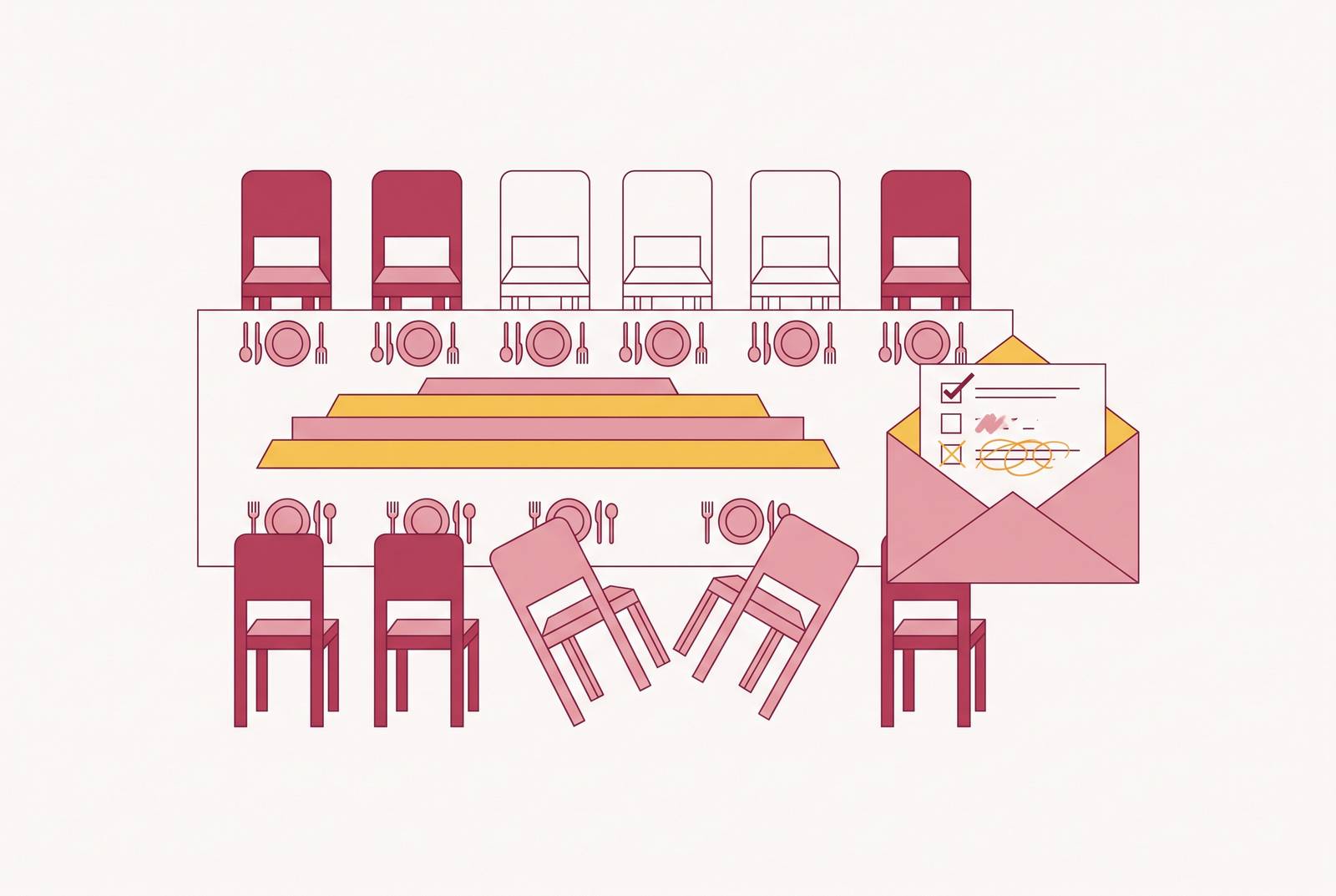
Guest list chaos costs real money, not just peace of mind. Cheryl Fernandes, owner and lead planner at Glitzzy Events, puts the true no-show rate at 3 to 5 percent of confirmed guests. That number gets confused constantly with a separate figure: the 10 to 20 percent of guests who make some kind of post-RSVP change, a cancellation, an addition, a dietary update, a plus-one swap. Couples who treat those as the same number are the ones who get blindsided, and mixing them up is exactly where the panic starts.
A couple who assumes 3 to 5 percent is the ceiling on change gets ambushed by the dietary updates, the plus-one confusion, and the "actually, can my brother come now" texts that push the real change rate toward 20 percent. Both figures are correct. They measure different things, and building a plan around only one of them is a mistake most couples make exactly once.
On a 150-guest wedding, even the conservative 3 to 5 percent no-show rate means paying for 4 to 7 meals nobody eats, at $170 to $220 per head for food and beverage alone. That's a four-figure line item on the invoice, whether anyone at the reception notices the empty chairs or not.
Cassie Morales, owner and planner at Heavenly Day Events, tracks why cancellations happen, and most reasons have nothing to do with the couple. Illness and family emergencies top the list. On-call employees get pulled into work. Flights get delayed by weather. The counterintuitive part: local guests cancel more often than guests who've already paid for flights and hotels. Once someone has money sunk into travel, they show up unless something serious happens. The guest driving twenty minutes down the road turns out to be the less reliable RSVP.
None of this is preventable, and treating it as preventable is where couples waste energy. Cancellations are baked into every guest list past a certain size. The only real lever is a system that catches the change early enough to act on it, rather than finding out three days before the wedding and scrambling.
Why vendor deadlines make a late-arriving headcount so damaging
Every vendor works backward from a date that has nothing to do with the wedding itself. Most Australian venues need a final headcount roughly two weeks out. Caterers typically need their number before the venue's own cutoff, leaving the couple's RSVP deadline needing to land well ahead of both. Stacking those two deadlines means the couple's own RSVP deadline can't sit anywhere near the wedding date. It needs to land 3 to 4 weeks out, leaving 1 to 2 weeks of runway to chase down non-responders before the venue locks the number.
Destination weddings compress the timeline in the other direction. Guests need to commit to flights and lodging before the caterer's deadline even becomes the binding constraint. Destination RSVP deadlines typically move to 6 to 8 weeks out as a result. Sending those invitations on a local wedding's clock leaves guests still shopping flights after the kitchen order is already locked.
Caterers charge a per-head fee for any guest added after the headcount gets submitted, and that fee is the single best argument for chasing non-responders before the deadline, not after. A guest added the week of the wedding doesn't just cost the standard per-plate rate. It costs that rate plus a penalty for disrupting a kitchen order that's already been planned, shopped, and prepped around a fixed number.
Dietary requirements ride the same clock, with their own failure point built in. The full list, vegetarian, vegan, gluten-free, nut allergy, halal, kosher, needs to reach the caterer at the same moment as the final headcount, not trickle in over the following week. A 10 percent buffer on dietary meals is standard practice, because guests routinely forget to mention a requirement until the RSVP form reminds them it exists.
A severe allergy is not a preference. Treating it like one is a safety failure, not a planning oversight. A guest who mentions gluten sensitivity needs a menu adjustment. A guest with a nut allergy severe enough to require separate prep surfaces needs a kitchen protocol change, plus a front-of-house staff briefing. Pass both along as the same kind of note at the final vendor meeting, and a manageable dietary list turns into a real risk on the wedding day.
A headcount that arrives late, or gets revised in a panic the week of, leaves every vendor downstream guessing. That's the entire argument for building the system before the final month starts, not during it.
Setting an RSVP deadline that produces a usable number
Setting the RSVP deadline too close to the wedding date is the single most common mistake couples make, and it does the most damage of any scheduling error on this list. It collapses the buffer completely and hands the couple a frantic final week instead of a calm one.
3 to 4 weeks out is the window that works for most Australian weddings. Push that to 5 to 6 weeks for a holiday weekend, when guests are juggling their own travel plans, or for a destination wedding. Larger guest lists of 150 or more may actually need additional runway, since the bottleneck is chasing individual non-responders, and more guests means more people to track down.
Vague wording on the invitation causes couples to lose track of RSVPs. A specific calendar date beats vague language every time: "Please respond by August 22, 2026" does real work that "as soon as possible" never will, because the second phrase invites procrastination by naming no consequence. The RSVP date deserves to be one of the most visible lines on the card.
A deadline without a stated policy leaves guests guessing what happens if they miss it, and that ambiguity produces the "maybe" pile a couple ends up chasing in the final week. Language along the lines of "If we haven't heard from you by [date], we'll assume you're unable to attend and offer your spot to our waitlist" removes the guesswork and forces undecided guests to commit before the vendor deadline, not after it.
Wait 2 to 3 days after the deadline passes before following up. By then, a short, direct text lands better than another formal email, since the guest already knows they're late and a friendly nudge closes the loop faster than a reminder that reads like the first one.
A growing share of couples now run RSVPs through a wedding website with a live form, letting guests update their own status instead of texting the couple directly. That shift cuts down the manual chasing considerably, because the form becomes the single place a change gets recorded, instead of a text thread the couple has to remember to relay to a spreadsheet by hand.
Plus-ones deserve their own line item on the form, not an assumption. State the policy outright, and add a line at the top reading something like "This invitation is for [Guest Name]. Please confirm the exact number of guests attending." A guest who sees their name printed next to a specific headcount field is far less likely to show up at the reception with an uninvited date in tow.
Building a planning buffer into the headcount before the final month
Plan against the 3 to 5 percent no-show benchmark, not against the fantasy that every yes appears at arrival. If 150 guests RSVP yes, the realistic arrival count sits closer to 142 to 145. Building toward that number produces a buffer that actually works, instead of one that only gets discovered the week of the wedding.
Guest lists are shrinking under budget pressure, with couples now inviting fewer guests than they originally planned, with the average reduction sitting around two dozen. That shift doesn't shrink the gap between invited and attending. It widens it in relative terms, since a smaller, more curated list still carries the same percentage of no-shows.
A couple of tactics make the buffer physical instead of theoretical. Round tables built for 8 can almost always seat 9 without anyone noticing, and a 9-top can shrink to 7 and still look full. Building one or two of these flex seats per table absorbs a late cancellation without leaving a visible gap at the reception. A table that loses two people to a cancellation still holds together socially, without leaving strangers staring at each other across empty chairs, when guests who share dietary needs or close social ties are seated at the same table.
Group cancellations deserve special attention, because they don't behave like single cancellations. Three or four guests from the same friend group who travel together can vanish from the count overnight, dropping the headcount by several people in a single message. That's one seating and catering adjustment that needs to happen all at once, immediately, not staggered over a few days.
Some couples keep a short B-list: guests who missed the first invitation round but could be brought in if a confirmed RSVP cancels early enough. This only works if the couple can see their live headcount and act on a cancellation within days, not weeks. Without a real-time view of who's actually confirmed, the B-list is just a list, not a tool.
A buffer is a number on paper until the couple has a live, accurate read on their headcount at any given moment.
Tracking headcount in real time so cancellations show up before they become a crisis
Most couples track RSVPs across a spreadsheet, a couple of email threads, and whatever texts land in their phones. That's the setup where cancellations get lost. When a cancellation arrives by text, it doesn't update the spreadsheet on its own. The caterer's number stays wrong, the seating chart stays built on information that's no longer true, and nobody notices until the final walk-through.
A live tracking system closes that gap by design, reflecting every change, a new confirmation, a cancellation, a dietary update, immediately in the couple's view of the guest list. Dietary requirements and attendance status live in the same record, so a late allergy notice doesn't need to get manually matched back to the right name under time pressure. When it's time to hand the number to the caterer, the export is already clean.
Dietary tracking isn't a side issue, either. A majority of couples now need to accommodate multiple dietary requirements across their guest list, so the dietary column carries as much weight as the attendance column, not less.
The seating chart is where a disconnected system does the most damage. A late cancellation needs to flow through to the seating arrangement automatically. Without that connection, the same change has to get made by hand in three places: the guest list, the seating chart, and the caterer's count. Three separate manual updates for one cancellation is exactly where a number gets missed, and it always seems to happen the week everyone's least equipped to catch it.
Couples not using a connected platform still have a fix. Couples should pick one tool, whatever it is, and make it the single source of truth for headcount. Route every RSVP change there, no exceptions. Fragmented tracking across text, email, and spreadsheet is the structural reason a late cancellation feels like an emergency instead of a routine Tuesday afternoon update.
What to communicate to vendors when the count changes
Laid out end to end, the vendor timeline runs like this. RSVP deadline on the invitation, 3 to 4 weeks before the wedding. Dietary requirements confirmed and sent to the caterer, at or before final headcount submission. Final headcount to the venue, roughly two weeks out. Final headcount to the caterer, before the venue's two-week cutoff. Any change after submission gets reported immediately, in writing, no batching it for later.
Notify the caterer the moment a cancellation happens, rather than waiting to bundle it with other updates. That timing alone can avoid unnecessary catering expense entirely, but only if the couple already knows about the cancellation fast, which loops straight back to the live tracking argument above. A system that surfaces the change in real time makes fast notification possible.
Silence is the expensive option here. Once the vendor deadline has passed and a cancellation goes unreported, the couple pays the full per-head rate for a plate nobody touches. That's the direct financial consequence of sitting on news instead of forwarding it the same day.
Dietary changes that are reported close to the wedding date need different levels of urgency depending on severity, and treating them all the same is a mistake. A mild preference change mentioned the week of the wedding is a footnote. A severe nut allergy notified that same week is an urgent call to the caterer, because kitchen protocol, separate prep surfaces, and a front-of-house briefing all take lead time to arrange. None of that happens instantly just because the couple asked nicely.
Somebody other than the couple should own vendor communication in the final two weeks. A planner, a day-of coordinator, or a trusted member of the wedding party, briefed properly, is far better positioned to field a last-minute cancellation than a couple who's supposed to be at rehearsal dinner instead of fielding caterer calls.
If there's no professional coordinator on the team, that handover needs to happen in writing before the final week starts. Give that person the caterer's and venue's contact names, the confirmed headcount, and clear instructions for what to do if one more cancellation lands. A verbal handover is functionally the same as no handover once the week turns chaotic.
Handling the five most common late-stage RSVP disruptions without scrambling
At least two of these five scenarios occur at nearly every wedding with 60 or more guests. Knowing they're coming, instead of treating each one as a fresh surprise, is most of what separates a calm response from a scramble.
Illness, a family emergency, a work obligation, a delayed flight: these are the top of Morales's list of common causes, and the response to all of them is mechanical. Update the live headcount, notify the caterer in writing, reassign or pull the seat from the chart. If a B-list guest could realistically fill that seat in time, reach out, but only if there's enough runway left for them to accept and plan around it. A last-minute invite nobody can actually take wastes the time spent extending it. That distinction matters because it separates a footnote from an urgent call to the caterer.
The surprise plus-one is easier to prevent than to manage on the day. An explicit plus-one policy and a named-guest field on the RSVP form heads most of these off before they ever reach the venue. For the ones that slip through anyway, a flex seat or two per table, the same 8-becomes-9 trick from the buffer section, absorbs it without anyone at the table noticing a scramble happened.
The "maybe" that never converts is a policy problem more than a people problem. Deadline consequence language, "if we don't hear from you by [date], we'll assume you're unable to attend," forces the undecided to commit before the vendor deadline instead of after it. Once that deadline passes, treat every non-responder as absent for catering purposes. Holding a plate for a guest who never confirmed is how the empty-plate cost builds, meal by meal, until it's a real number on the final invoice.
The 10 percent buffer on dietary meals exists for exactly this: the late dietary change. Guests forget, then remember two weeks out, and the buffer absorbs most of that without a panicked call to the kitchen. A severe allergy notification can't get lumped in with routine forgetfulness, though. That gets flagged and handled separately, with the lead time a kitchen actually needs to change protocol.
The group cancellation, three or four guests from the same travel group dropping out together, knocks 3 to 4 percent off the headcount overnight and leaves a table without its social anchor. The fix is either consolidating the remaining guests at that table into another one with room, or filling the vacated seats from the B-list if there's still time. Whatever the fix, it needs to hit the seating chart before escort cards go to print. A manual reconciliation after printing is a far bigger headache than a five-minute software update beforehand.
How the day-of fallback keeps late cancellations from reaching the couple
Every system built in the weeks before the wedding, the buffer, the live tracking, the vendor timeline, exists for one purpose: keeping the wedding day itself boring from a logistics standpoint. The single point of contact assigned for the final two weeks carries that job through to the day itself. That person, not the couple, hears about a cancellation that lands the morning of, and that person decides among removing a seat, reassigning a plate, or calling a B-list guest.
That handoff only works if it was set up properly beforehand, in writing, with names and numbers attached, rather than improvised in the middle of a reception. A couple who spent 3 to 4 weeks building a buffer and a live tracking system has already done the hard part. The day-of fallback is just the last link in that chain: the mechanism that makes sure a cancellation at 9 a.m. on the wedding day gets absorbed by a coordinator with a plan, instead of reaching the couple as a crisis they have to solve between getting dressed and walking down the aisle.