How Plus-One Policies Affect Australian Wedding Budgets and Seating
Each plus-one adds hundreds of dollars to the final bill, making a consistent policy essential.

What Australian weddings cost, by city and venue type
Per-person pricing is the number every couple needs to hold in their head before they approve a single plus-one request. Not the guest's relationship status. Not the discomfort of saying no. Australian venues and caterers charge by the head, so a plus-one was never a manners question. It is a line item that lands on the final invoice whether anyone budgeted for it or not.
In Sydney and Melbourne, all-inclusive packages generally run $170 to $250 per head, and premium venues push into the $250 to $300 range. Sydney catering alone costs $100 to $280 per person, averaging around $160, so a 100-guest wedding there means $16,000 to $20,000 for food and drink before a single other cost gets added. Regional venues bring that down to roughly $130 to $170 per head, which sounds like relief until you run the multiplication. Every added guest still multiplies against that per-head rate. A couple who treats a regional wedding as cheap enough to relax about ends up just as overexposed as one in the city, only at a smaller scale.
The standard plus-one rules most Australian couples use
Most couples get the question of who qualifies for a plus-one backwards. They treat it as a gut check about who is serious enough to deserve an extra invite, when the only thing that actually holds up under scrutiny is a rule applied the same way to everyone. A handful of conventions have survived across most Australian weddings for exactly that reason: they're defensible, and they don't demand a fresh judgment call for every name on the list.
Married, engaged, or long-term couples (together a year or more, as a rough line) get a plus-one by default. Guests who won't know anyone else at the wedding get one too, so nobody spends the night alone at a table of strangers. Wedding party members get one as standard, since bridesmaids and groomsmen work the event rather than experience it as guests, and if one bridesmaid gets a plus-one, all of them do. Co-workers get invited as a full group rather than one at a time, so nobody's left explaining to a desk-mate why they got skipped. Kids follow an all-or-nothing rule: every child on the list gets an invite, or none do. A mixed approach is the fastest route from a wedding to a family feud.
Some couples run the stricter "no ring, no bring" version, where plus-ones only go to guests who are already married or engaged. It keeps the list tight, but it risks friction with people in serious relationships who just haven't made it official yet. Destination weddings often pull the opposite direction, with many couples choosing to extend plus-ones more generously given the added effort guests are already making to attend.
Whichever version gets chosen, one rule outranks all the others: consistency. Guests will accept almost any policy if it applies evenly. What they won't forgive is watching one friend get a plus-one while someone in an identical situation doesn't.
How guest count uncertainty compounds the budget overshoot problem
Couples have budgeted an average of $29,471 and ended up spending $38,252, a 23 percent overshoot, and guest list finalisation is cited as one of the main reasons early estimates drift so far from final ones. The same data shows couples expected 108 guests on average but ended up with 85. That gap does not stay contained to the meal count. It ripples through venue sizing, drink orders, furniture rental, invitation printing, staffing, cake size, transport, and accommodation blocks, all tied to a number that keeps moving underneath the plan.
The two figures point in opposite directions, and that is the trap. Couples over-invite early, inflating the guest list and the mental budget before a single RSVP lands, then cut late, often after some of those costs are already locked in and non-refundable. Plus-ones sit right in the middle of that swing. They typically get added after the venue is booked and the per-head rate is signed, so every late plus-one is added cost that arrives after the core budget is already committed.
Setting a plus-one policy that holds under pressure
Venue capacity and the per-head rate should be determined before the guest list. That order is not a suggestion. The budget ceiling has to exist before a single name gets written down, or the whole planning process runs backwards from a number nobody actually set.
Set the total number of guests the budget can support first. Then decide how many of those seats can go to plus-ones. A policy holds if it keeps that sequence, and it falls apart the moment "just this one exception" gets made for a favourite cousin or a persuasive best friend. That exception becomes the new precedent, and everyone who hears about it expects the same treatment.
A tiered list makes the sequence concrete. The must-invite guests, immediate family and closest friends, make up tier one, and anyone married, engaged, or in a long-term relationship is a natural candidate for a plus-one. Tier two covers extended acquaintances and colleagues below a certain closeness threshold, invited without plus-ones and with no individual exceptions. Tier three stays in reserve, invited only if numbers allow once RSVPs start coming back, rather than going out with the first wave.
The seating problem that unresolved plus-ones create
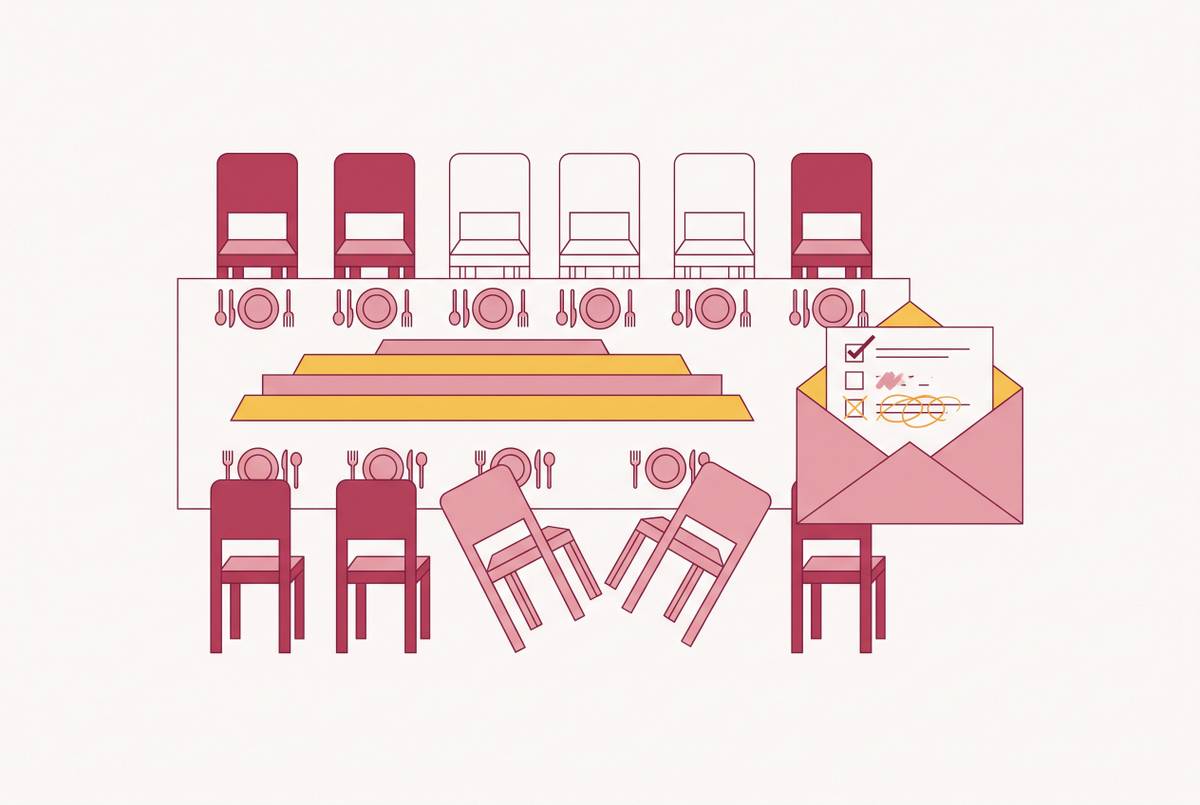
An unconfirmed plus-one is a seating chart problem before it is ever a dinner-count problem. A guest whose plus-one's name is not locked in until the final week leaves a hole in the chart, or forces a full table rebuild days before the event.
The fix is procedural: every guest bringing a plus-one supplies that person's full name by the RSVP date. Once names are in, seating still takes judgment. Unfamiliar plus-ones do best seated with socially confident, easygoing guests who will pull a newcomer into conversation without being asked. Grouping every unknown plus-one at one table just builds an island of strangers. It just builds an island of strangers.
Dietary needs stack on top of that. A plus-one confirmed late almost always means a dietary requirement confirmed late too, such as an allergy, a vegetarian meal, or a halal requirement, and the kitchen needs real lead time to handle it. That pressure lands on the caterer, and the kitchen needs real lead time to handle late requirements reliably.
Why tracking plus-ones in a spreadsheet creates compounding errors
The failure here is structural. When the plus-one list lives in one spreadsheet tab, the seating chart in another, and dietary requirements in a third, a single update, one confirmed plus-one, has to get copied by hand across all three, every single time it changes.
Trace what actually happens when a plus-one confirms. The guest list needs updating. The seating chart needs a new name slotted in. The dietary list needs amending if there is a requirement. The caterer's final head count needs revising. In a spreadsheet, each of those is a separate manual step, and each step is a place where something drops.
The failure modes repeat themselves across weddings. A plus-one's name makes it onto the guest list but never makes it into the place card print run. A dietary note gets logged for the primary guest while the plus-one's allergy sits unread in a separate email thread. A seating chart gets finalised and printed before the last plus-one RSVP even comes in. None of these sink a wedding on their own. Each is fixable in isolation. A missing place card or an unlisted allergy tends to surface the morning of the wedding because that is when nobody has the bandwidth to solve it calmly, and it becomes visible at the exact moment the pressure is highest.
A practical plus-one budget calculator couples can run before invitations go out
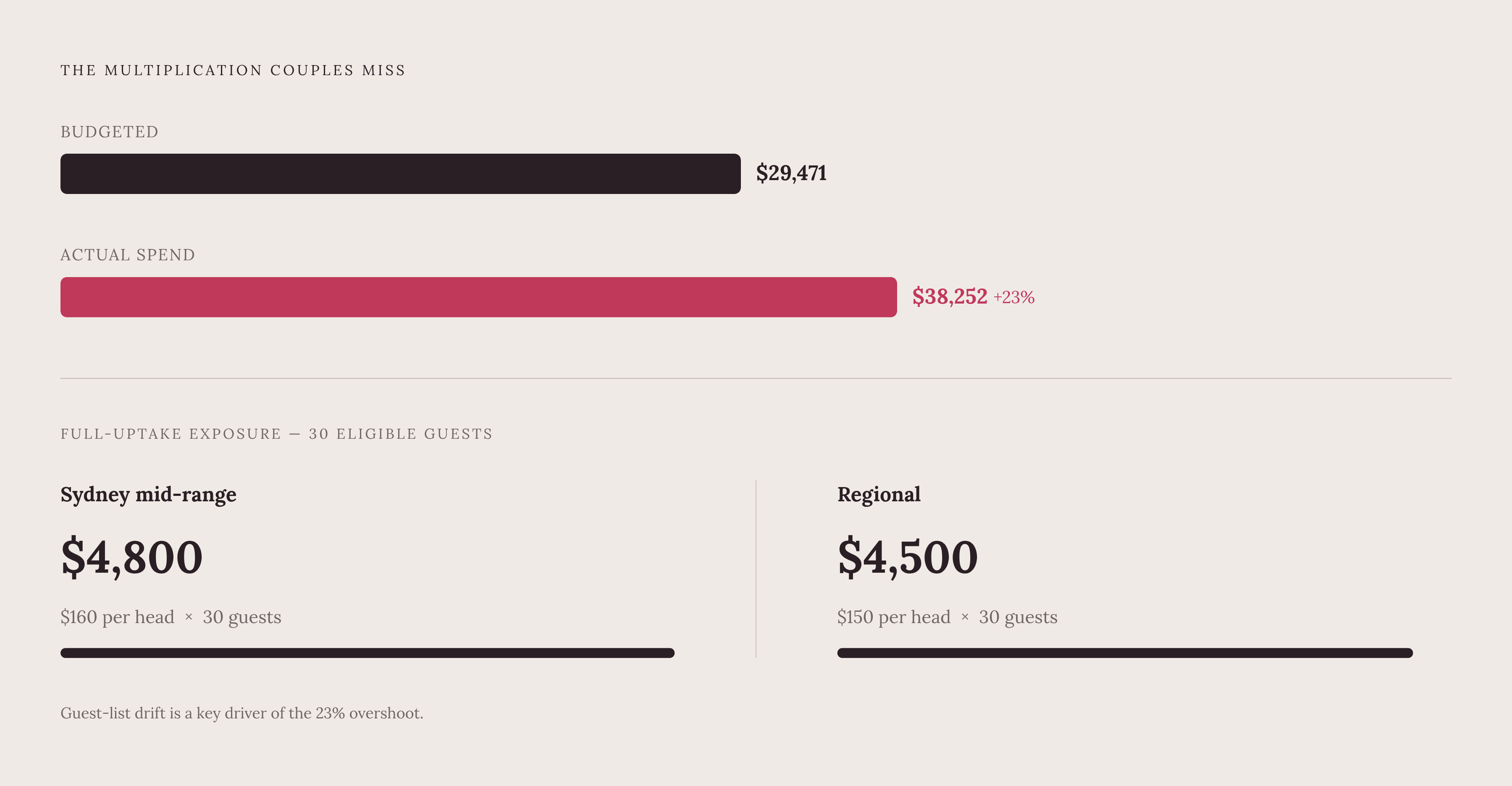
The formula fits on a phone calculator: number of eligible guests, multiplied by the per-head rate, equals maximum plus-one cost exposure. Run it before a single invitation goes in the mail, not after the RSVPs start rolling in.
Take a Sydney mid-range example. Thirty guests are eligible for a plus-one under the couple's policy, at $160 per head. If every one of them brings a guest, that is a substantial amount in exposure the budget needs to absorb, on top of everything already committed. Even at a partial acceptance rate, that is still a real number, and it belongs on the budget spreadsheet next to the venue deposit, not as a surprise line three weeks before the wedding.
Run the same math on a regional wedding at $150 per head with the same 30 eligible guests: full uptake comes to $4,500. The dollar figure shifts with the venue. The planning logic does not: know the ceiling before the invitations go out, because couples who skip this step are the ones who land inside that 23 percent overshoot.
Communicating a plus-one policy clearly and without awkwardness
A wedding website is the natural place for this. A short, warm paragraph on the FAQ or guest info page sets expectations before invitations even land, and it gives guests a way to check the answer for themselves instead of having to ask directly and risk feeling like they are prying.
Invitation addressing does most of the talking without a word of explanation. An envelope or digital invite reading "[Name] and Guest" signals one thing. "[Name]" alone signals another, just as clearly, with nothing spelled out and nothing to argue with.
Wording shapes how a policy lands, so frame it around the experience being built rather than the reasoning behind it. Keeping the celebration intimate, so every guest sits with people they actually know, lands better than leading with the budget math, even though both are true. One is warm. The other sounds like an excuse, even when it is not.
For guests who ask outright, a steady, consistent answer works best: plus-ones have gone to married and long-term couples to keep numbers manageable, full stop. That answer holds up because there is no exception sitting behind it waiting to be explained away.