Collecting Dietary Requirements From Guests Before the RSVP Closes
Embed dietary questions into your RSVP form to prevent last-minute catering chaos.

What "collecting dietary requirements" means: preferences, restrictions, and allergies are not the same thing
Two weeks before the wedding, the caterer calls asking for final meal counts. Most couples discover, at that exact moment, that dietary information was never actually collected properly. It's scattered across a text here, an email there, a comment someone made at the engagement party months ago that nobody wrote down. That scattering is a design failure, and it starts with treating dietary questions as a follow-up task instead of building them into the RSVP itself. It is a design failure, and it starts with treating dietary questions as a follow-up task instead of building them into the RSVP itself.
The fragmentation is what causes the panic. One guest texts a starter choice. Another emails about a nut allergy three weeks after confirming attendance. Someone forgets to mention they're vegetarian until the week of the wedding, because nobody asked while they were paying attention. Every reply lands in a different format, a different inbox, at a different time, and by the time someone tries to compile it all, half of it has gone missing.
Not every dietary answer carries the same weight, and that's where most couples get it wrong: they treat preference, restriction, and allergy as one field on a form. A guest picking between chicken and fish is answering a preference question. A guest whose meal has to be prepared separately, on different equipment, checked by someone in the kitchen before it goes out, is answering a question about safety. Those two guests should never be funneled through the same tiny text box.
Split it into three tiers, because each behaves differently once it hits the caterer's kitchen:
Lifestyle choices, like vegetarian and vegan. Common, easy for most caterers to manage, usually solved with a simple menu selection. Medical and religious restrictions, like gluten-free, dairy-free, halal, kosher, and coeliac disease. These need advance coordination and often a separate prep line. Allergies, like nut, shellfish, sesame, egg, and soy. This is the safety-critical tier. A nut allergy needs strict, unambiguous handling, and the caterer needs to know exactly where that guest is sitting.
A mild preference and a life-threatening allergy cannot share a field and get treated with equal seriousness by whoever reads the spreadsheet later. The form needs a way for guests to flag urgency alongside stating a category.
Scale makes this non-negotiable. Something close to 1 in 5 wedding guests carries some form of dietary restriction. For a wedding of 100 guests, that's roughly 20 data points to track, not two or three exceptions handled from memory.
Why the RSVP is the right moment to ask
Guests are already paying attention when they RSVP. They're logged into the wedding website or filling out the card, thinking about the event, confirming they're coming. Adding one more question right there costs almost nothing. Asking separately, later, costs a lot, and this is the point most couples get backwards: they treat dietary information as an afterthought instead of a line item on the same form.
Bundling the dietary and meal-choice question into the RSVP does three things at once. It saves the couple from chasing guests twice. It keeps attendance and catering data in the same place instead of splitting across two. And asking on the RSVP surfaces allergies early enough to actually plan around, instead of finding out during the final headcount call.
Asking later looks like this instead: a follow-up email goes out weeks after the RSVP deadline, lands in an inbox already cluttered with vendor confirmations and gift registry notifications, and gets ignored. Guests who already confirmed attendance feel pestered over something that should have been asked the first time. Some never reply. Others reply vaguely, because the context that would have made them think carefully has already passed.
Venues and caterers set firm deadlines for finalising menus, and missing that window tends to mean extra fees or a shrunken set of menu options. By the time that deadline is bearing down, re-contacting guests for the third time is damage control. It's damage control dressed up as one.
Building the RSVP form so guests complete it
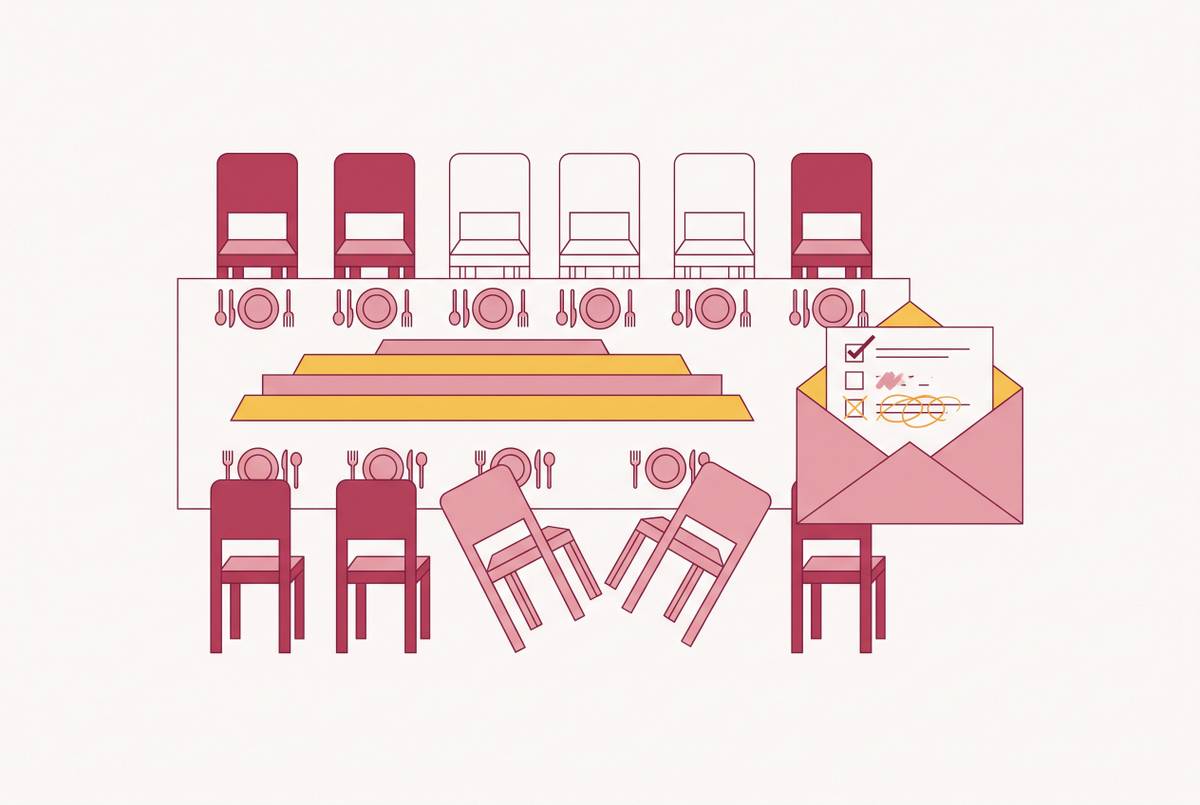
The format that works: a short checklist of common categories, plus one open text field. Cover the common categories that come up repeatedly in the checklist, things like vegetarian, vegan, gluten-free, and major allergens. Use the free-text field to catch what the checklist misses, because allergies and medical diets rarely fit neatly into a dropdown.
A blank open question on its own produces vague, preference-level answers that don't tell the caterer much. Checkboxes produce usable data. Caterers consistently point to the combination, structured checkboxes plus an "other" field, as the version that actually works on their end.
Ask per guest, not per household. A family of four responding together can carry four different answers: one vegetarian, one with a shellfish allergy, two with no restrictions. A single household-level field flattens all of that into one line, and someone, usually the couple, usually at the worst possible time, ends up untangling it by hand.
Add a severity signal wherever allergies show up. A simple question, "how severe is this allergy: mild, moderate, or severe," gives the caterer something concrete to act on. Without it, a guest who mildly dislikes peanuts and a guest who'll go into anaphylactic shock from cross-contamination look identical on paper. That gap is exactly where the serious mistakes happen.
Handling plus ones, children, and multi-event guest lists without gaps
Plus ones need their own line, full stop. The RSVP form should collect dietary information for each named plus one individually, because a single combined field loses the detail the second there are two people with two different needs sharing it.
Children's meals are a judgment call to be made case by case. Add a dedicated children's meal option only if the caterer actually needs a separate count for it. Otherwise leave it off the RSVP and note it on the catering order form instead. Forcing every parent through an extra field they don't need adds friction without producing anything useful.
Multi-event guest lists need segmenting by tier. Couples running a day with different guest groups, some invited to the full day, some only to the evening reception, should split the food questions to match. Evening-only guests almost never need a meal choice, and asking anyway wastes their time and muddies the dataset with answers nobody will use.
Rehearsal dinners and other pre-wedding events need separate handling. If an event has its own catering arrangement, it needs its own dietary question attached. Data collected for the wedding reception does not carry over automatically, even for the same guest.
Getting guests to complete the RSVP, including the food questions
Set a clear RSVP deadline and put it somewhere on the invitation guests cannot miss. Collecting RSVPs well ahead of the wedding leaves enough runway to chase stragglers while still meeting the caterer's own cutoff.
QR codes fix a surprising amount of friction here. Printed on the invitation or a detail card, they take guests straight to the RSVP page without anyone typing a URL from memory. That matters most for guests working off a physical invite, who would otherwise have to go hunting for the website separately.
Going digital does not mean abandoning paper. RSVP cards alongside save-the-dates still matter for guests who would rather skip a digital platform, and that is fine, as long as those paper responses get logged into the same tracking system as everyone else's. A separate pile of cards sitting in a drawer defeats the entire purpose.
Sequence the form so food questions only appear after attendance is confirmed. A guest declining the invitation has no reason to be asked about gluten-free options, and forcing them through it anyway adds friction to a form that should take thirty seconds.
What to do with the dietary data once it's collected: getting it to the caterer cleanly
RSVPs feed the guest list, the guest list feeds the seating chart, and the seating chart feeds the kitchen. That chain has to hold at every link. Break one connection, say, dietary answers sitting in a separate inbox from the seating spreadsheet, and the data drifts or disappears before it reaches anyone actually cooking.
For anything safety-critical, like a nut allergy, the caterer needs two pieces of information together: the requirement itself and the exact seat that guest occupies. A list of allergies with no seating attached is only half useful. Kitchen staff plating fifteen tables need to know which plate goes where and which guests have a problem.
The cleanest handoff is a single exported list: name, dietary requirement, severity where relevant, and table or seat number, all in one document handed to the caterer directly. Some RSVP platforms already store dietary answers alongside the RSVP response itself, which makes that export a non-event when the caterer asks for it. Whichever platform is doing the work, the principle stays the same: RSVP data and seating data need to live in one system, not two.
Spreadsheets can work, but only if the spreadsheet is the single live version everyone updates. Once dietary information starts living partly in a text thread, partly in an email, partly on a paper card nobody has transcribed yet, the spreadsheet stops being a source of truth. It just becomes one more competing version of the same information.
Australian wedding planning tools that handle dietary collection inside the RSVP
Plenty of wedding planning roundups lean on platforms built for the US market, and for couples planning locally, that's a real mismatch. Vendor listings thin out fast once you're searching for Australian caterers and venues, and pricing structures often assume a market that isn't this one. Australian couples need tools built around how weddings actually run here, not adapted from somewhere else.
Judge any platform against a specific set of functional requirements for dietary collection, not against how polished the interface looks:
- Dietary restrictions get collected inside the RSVP form itself, not bolted on through a separate contact form afterward.
- Data is captured per guest, never lumped together per household.
- Dietary answers are stored alongside the RSVP response, not filed off in a different system.
- The attendee list can be exported with dietary data included, ready to hand to the caterer.
- Dietary data connects to the seating chart, ideally without manual re-entry.
A beautifully designed RSVP page that dumps dietary answers into an unlinked spreadsheet still leaves the couple doing the reconciliation work by hand, which is exactly the problem the RSVP was supposed to solve.
Sources
- Meal Choice Wording for Wedding RSVP Cards - Paperlust
- How to Ask Guests for Meal Choices on Your Wedding RSVP · Guestlive Journal
- How to plan for dietary requirements when catering your wedding — Fed by Jed
- Wedding RSVP Wording for Dietary Restrictions & Meals
- quikrsvp.com
- Breaking down your wedding guests’ dietary requirements
- Wedding Dietary Requirements: A Complete Guide
- How to Cater for Dietary Requirements | Vogue Ballroom