The Hidden Cost of Manual RSVP Collection for Large Weddings
Spreadsheets and voice notes add hundreds of hours and thousands in hidden vendor costs.

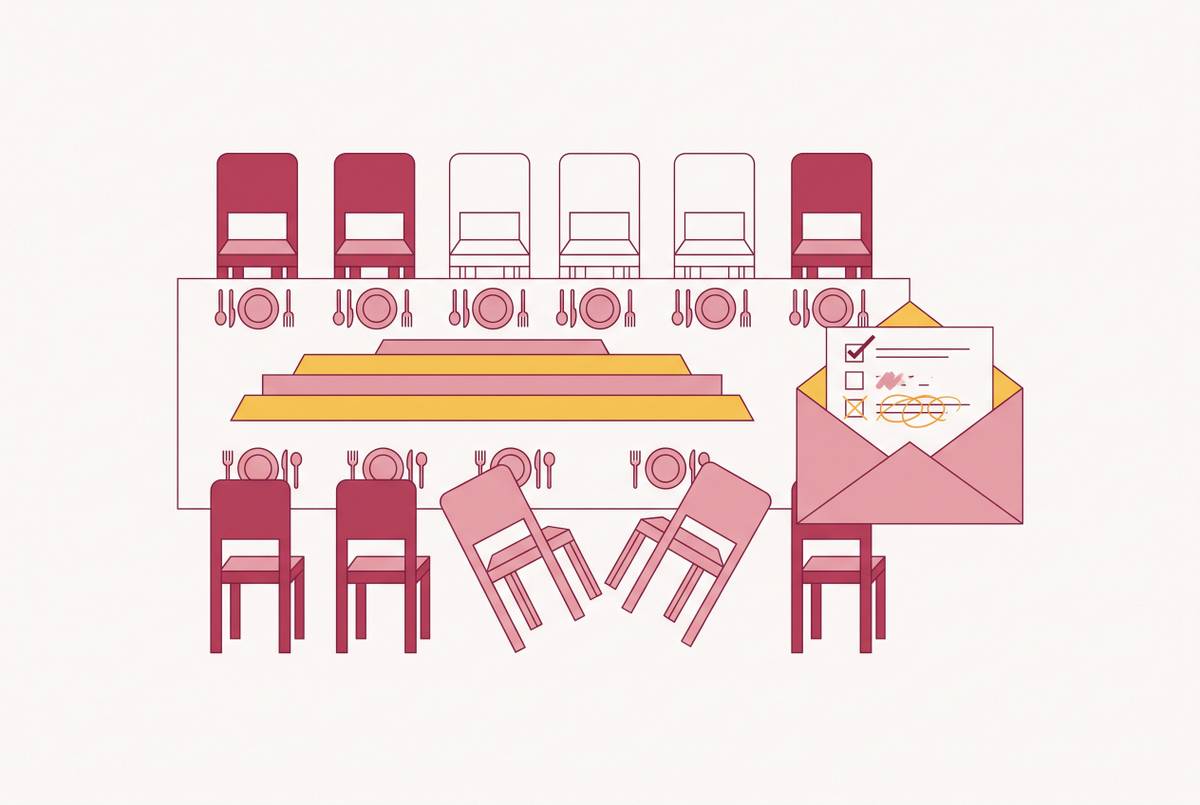
The spreadsheet drifts out of sync with the inbox by Wednesday. Someone adds two names on Friday. By Saturday morning, the venue has set the wrong number of chairs. That sequence is what happens, reliably, when the spreadsheet diverges from the inbox mid-week, the couple adds names on Friday, and the venue has the wrong setup by Saturday morning.
The root issue is that responses don't arrive through one channel. They come in through paper cards, email, WhatsApp messages, and phone calls, often on the same day, and nothing reconciles them automatically. A spreadsheet can hold data. It can't watch four inboxes at once or notice when the same family has replied twice in two different places.
Scale makes the mismatch worse, not just bigger. A 150-person wedding generates something like 300 to 400 individual data points once attendance, meal choices, dietary flags, plus-one names, shuttle requests, and table assignments are all counted, and every one of those has to reach a vendor eventually in a form the vendor can actually use. Bespoke Bride's post confirms this 300–400 data point figure and the same list of categories for a 150-person wedding, though it is a blog post rather than a formal analysis. Bespoke Bride published this analysis of RSVP data points at large weddings, framing it as editorial explanation within an RSVP-tracking guide rather than a formal data study. A planner encountered WhatsApp voice-note RSVPs as an unexpected input at a 120-person sit-down wedding, Bespoke Bride reported. At that 120-person Cotswolds sit-down, the planner discovered the WhatsApp voice-note RSVPs while reconciling responses, rather than having them arrive as a pre-documented input source. Martha Stewart Weddings' research, cited by Bespoke Bride, found that non-response rates climb as the guest list grows, so the biggest weddings carry the steepest reconciliation burden right when they can least afford it. Bespoke Bride's June 9, 2026 article attributes this pattern directly to Martha Stewart Weddings, noting that the larger the guest list, the steeper the non-response rate.
Late and incomplete responses set the cost chain in motion
The majority of large-wedding couples do not receive their RSVPs by the deadline they set, so manual follow-up is the default workload, not an edge case.
Data from ohmyguests.com backs this up directly: a significant majority of couples end up with fewer cards back than expected by their requested date, and someone has to go chase the rest by hand. RSVPify's internal figures, cited by Bespoke Bride, show roughly half of all responses land within the first four and a half weeks. The other half arrive close to the deadline or after it. Every couple ends up managing a long tail of stragglers no matter how clear the invitation was. A meaningful share of guests won't respond at all unless someone nudges them, Martha Stewart Weddings found.
The knock-on effect appears in behaviour, not just paperwork. Easy Weddings' 2026 Australian Wedding Industry Report ranks guest list management as the second-biggest planning stressor, behind only budget, and finds couples are now inviting an average of 23 fewer guests than they originally planned. That's not a footnote. Couples are shrinking their guest lists in advance because they already expect the RSVP process to be unmanageable at scale.
Suppliers generally recommend setting the RSVP date three to four weeks ahead of the numbers deadline the venue needs, which leaves roughly a week to chase stragglers before the caterer's own 14-day cutoff. But moving the deadline earlier isn't a fix on its own. Setting the deadline too early backfires: Paperlust's guide notes that an 8–10 week deadline can frustrate guests and produces lower initial response rates, more post-deadline changes, and an inflated follow-up workload, adding a second round of chasing rather than eliminating it. Tightening the buffer just relocates the problem.
The labour hours that accumulate before a single vendor receives a number
Couples consistently underestimate how many hours manual RSVP tracking actually takes, and the hours don't cluster at one point. They build up at every stage, from the first reply card to the final seating chart.
Across six major event-planning agencies surveyed in 2024 and 2025, the median came out to 34 hours of planner labour per 200-person event, and that's before any vendor recovery work starts once numbers turn out to be wrong. At the 120-person wedding mentioned earlier, with three meal choices plus a children's menu, the planner spent a full working day reconciling paper cards against the Google Sheet. She caught two duplicate entries, one family counted twice because both sets of parents had RSVPed separately, and three guests whose replies had come in as WhatsApp voice notes. Her own summary of the day: "If they had used an online RSVP from the start, I'd have had four hours of my life back." Bespoke Bride reported on June 9, 2026 that at that 120-person sit-down wedding with three meal options and a separate children's menu, the couple's planner spent the equivalent of a full working day reconciling paper RSVPs against a manually maintained Google Sheet.
Couples who set up a centralised digital RSVP system from the outset spent far less time on guest-list admin in the final six weeks before the wedding, and the data they eventually handed to vendors was cleaner across the board. Labour hours are not evenly distributed: the heaviest load hits in the two weeks before the wedding, exactly when couples are under the most pressure from every other planning front.
How headcount errors translate into vendor costs
Manual tracking produces the wrong headcount often enough that it's the expected outcome, not the exception. Once it happens, the cost never appears as a labelled line item. It gets folded into catering bills, vendor recovery charges, and seat guarantees a couple can't undo after the fact. Average catering over-order costs run roughly $14–$22 per head, and on a large event that adds up to a sum already spent by the time the error is caught.
When a headcount is significantly off, open-text dietary fields produce inconsistent responses requiring manual clean-up, since the final headcount drives the catering guarantee, seating plan, and final invoices simultaneously. None of this is visible on a final invoice as "RSVP tracking error." It just looks like a bigger catering bill.
The deeper issue is that headcount, meal choice, and dietary data all have to feed the same guarantee, the same seating plan, and the same invoice at the same time. When they don't live in one place, open-text dietary fields produce inconsistent responses requiring manual clean-up, and "Option 1 / Option 2" meal labelling requires a separate reference document to decode. Fragmented RSVP data breaks that coordination before it starts.
Until the final headcount is locked, couples can't confirm the catering guarantee or finalise seating, so every extra day of RSVP uncertainty is a day of paralysis at the exact stage where mistakes cost the most. And the floor doesn't move: most caterers charge a minimum spend regardless of turnout, so couples who invite generously and then get fewer confirmations than expected never see that money again.
Different cost stakes across Australian cities
Catering and venue prices swing hard across Australian cities, so a headcount error costs a different amount depending on where it happens. A miscount at a Sydney or Melbourne wedding costs measurably more than the identical miscount would in Adelaide or Brisbane.
The average Australian wedding already carries a hefty price tag in 2026, according to the Easy Weddings Annual Wedding Survey as reported by wedadvisor.com. In Sydney specifically, venue plus catering together make up the single largest chunk of the wedding budget by a wide margin. Victorian couples spend a considerable amount on the venue alone in 2026. Brisbane sits well below the harbour-city price point, making it the best-value capital market in the country for a full-scale wedding.
Australian couples overshoot their original budget by 23% on average, and imprecise RSVP numbers feed that overrun directly, because every extra confirmed guest adds meaningfully to the catering line on its own. Every dollar wasted on vendor recovery from a bad headcount bites hardest in Sydney and Melbourne, where catering per-head rates are highest.
The downstream seating and dietary chaos that follows a bad headcount
Money isn't the only casualty. A bad headcount cascades straight into the seating chart and the dietary plan, turning an accounting problem into something guests see directly.
Easy Weddings' 2026 data shows well over half of couples need to accommodate multiple dietary requirements, and dietary data collected through inconsistent manual channels creates real risk of a guest receiving the wrong meal. When that information comes in through paper cards, text messages, and the odd verbal mention at a family dinner, the odds of a guest getting served the wrong meal go up sharply. Open-text fields make it worse: "no gluten," "GF," "coeliac," and "wheat-free" all describe the same restriction, but on a manually kept sheet they appear as four different entries that someone has to notice and merge by hand. Someone has to build and maintain a separate key just to translate the numbers into actual dishes.
None of this resolves itself once the wedding gets close. The seating chart can't be finalised until the headcount is locked, and escort cards, printed charts, and name cards all need production time before the day itself, as Paperlust's guide notes. A late headcount squeezes that production window or wipes it out entirely. Picture the same full working day the Bespoke Bride planner spent reconciling a 120-person guest list, duplicates and voice-note RSVPs included, except this time it's happening the morning of the wedding instead of weeks before it. That's the version of the RSVP failure chain nobody wants: the seating plan and the dietary list still getting untangled while the first guests are pulling into the car park.
The real cost of the "just use a spreadsheet" approach
A Google Sheet feels like the responsible, no-cost option. The Google Sheets approach feels like a free solution but is actually the source of most of the failure modes described above, because a spreadsheet is a static document that does not connect to the live flow of RSVPs, dietary data, or vendor exports.
The same limitation appears in budgeting tools built the same way. Knowing that "Catering" is a line item on a budget sheet does nothing for a couple who doesn't already know most caterers enforce a minimum spend regardless of guest count, or that drop-off catering sidesteps that minimum entirely, marriednotbroke.com's comparison of wedding planning tools shows. A spreadsheet with better formatting is still just a spreadsheet.
The mechanical problem is timing. A spreadsheet only reflects reality the moment someone manually types a new entry into it. A reply that lands somewhere the sheet's owner hasn't checked yet puts the sheet and the inbox out of sync. That's what happened at the 120-person wedding: a full working day spent finding duplicate entries and WhatsApp voice-note replies that the spreadsheet had no way of catching on its own.
A spreadsheet also can't do several things a large wedding actually needs done: send reminders to guests who haven't replied, export a meal count in a format a caterer can use directly, feed a seating chart, or flag a dietary clash before it becomes a plated mistake. Each of those requires a second tool, more manual work, or both. This holds true even across multi-event scenarios. The most common defence, "I'm organised, I'll keep it updated," runs into the same wall every time: the heaviest wave of late replies lands in the final two weeks before the wedding, when the couple has the least time and headspace to keep a sheet current. The question becomes what can survive the two weeks that matter most.
How digital RSVP tools close manual system gaps
A properly built digital RSVP system removes the manual reconciliation step altogether. Every response, attendance, meal choice, dietary flag, plus-one name, flows into one dashboard automatically, in a format vendors can use without anyone translating it first.
That changes the couple's relationship to their own numbers. Instead of adding up cards and texts by hand, the headcount stays current on its own, visible in real time whenever anyone checks it. Reminders to guests who haven't responded go out on a schedule the couple sets in advance. That single feature removes the most time-consuming part of manual follow-up.
Guest-code matching, where each invitee enters a unique code tied to their invitation, keeps the guest list the system holds lined up with the invitations actually sent, and prevents uninvited plus-ones from sneaking onto the final count. Combined with per-guest meal and dietary capture instead of the old "Option 1 / Option 2" shorthand, the data that reaches the caterer needs no decoding and no cheat sheet. It arrives usable, the first time, which is the one thing a spreadsheet was never built to do.