Mapping the Full Australian Wedding Planning Timeline to the Features One Platform Must Cover End to End
An all-in-one platform must connect Australian wedding budgets, guests.

An all-in-one wedding planning platform for Australian couples must connect the budget, venue and vendor bookings, guest list, RSVPs, seating plan and wedding-day outputs without making couples re-enter data. The platform must have Australian pricing and local planning deadlines as basic features. This timeline maps what the platform must do at each stage, from venue calls 18+ months out to guests finding their seats on the day.
Why Australian couples end up managing their wedding across five disconnected tools
Most wedding planning roundups are written for Americans. Australian couples get recommendations based on US pricing, vendor categories and registry systems that may need a US bank account. A tool can look useful at signup while leaving a couple to handle the Australian parts of planning somewhere else.
That is how the disconnected stack takes shape. The website sits in one app, RSVPs in another, the budget in a spreadsheet, seating in a separate tool and vendor discussions in email. Every hand-off creates another place where information must be copied or reconciled. How these tools make money helps explain the split, because many free platforms are vendor directories built to bring in enquiries. The tools chosen in month one therefore constrain what the couple can do in month eighteen.
How the Australian planning sequence works and why each stage gates the next
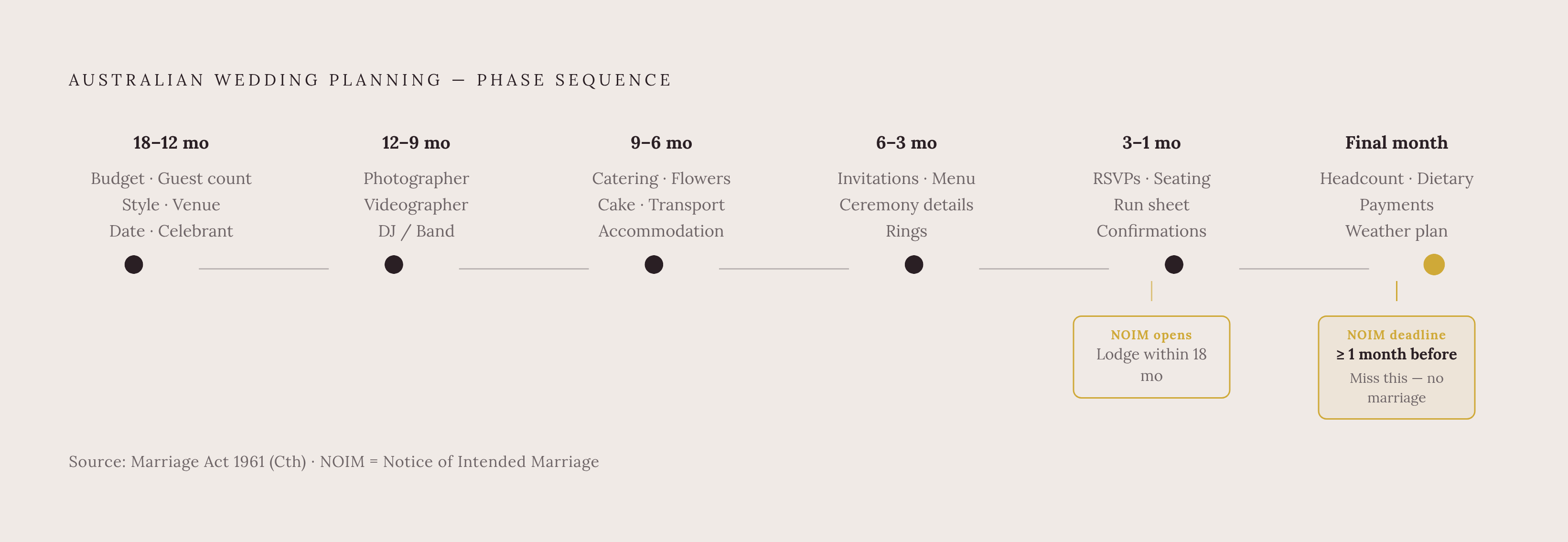
Budget and guest numbers come before venue decisions. They determine which dates, spaces and vendor tiers are realistic, so booking ahead of those decisions breaks the chain. The 18–12 months phase covers the budget, guest count, style, date, venue and celebrant. Peak-season venues in spring and autumn fill 12 to 24 months or more ahead, which puts couples with a preferred date under pressure before much else is settled.
At 12–9 months, attention turns to the photographer, videographer and DJ or band, followed at 9–6 months by catering, flowers, cake, transport and accommodation. Invitations, menu finalisation, ceremony details and rings follow at 6–3 months. RSVPs, seating, the run sheet and supplier confirmations occupy 3–1 months, while the final month brings the final headcount, dietary requirements, payments and weather contingency.
There is also a legal deadline to meet. Couples must lodge a Notice of Intended Marriage with their celebrant no fewer than one calendar month and no more than 18 months before the ceremony. Missing the one-month window means the marriage cannot legally proceed on that date. Supplier confirmations also need repeated attention in the weeks and days before the event. Each phase therefore needs a different capability, from cost modelling and deadlines to live guest records and day-of documents.
What the budget and guest list phase actually demands from a planning tool
An Australian budget tool needs to show AUD and base its benchmarks on prices in Australian cities. The tool must then update as guest numbers change, because venue and catering take a large share of the budget and many costs are per head. Guest count is the strongest lever on total spend. A calculator that ignores it cannot give a meaningful picture of what the wedding will cost.
Fixed percentage splits create a different distortion. They generally assume large weddings, so they can produce poor allocations when the guest count is smaller and costs do not shrink in the same proportions. A connected tool uses the guest list to work out the budget. Otherwise, every addition or removal leaves the couple to reconcile the numbers manually.
The budget also has to survive actual spending. Additions after the original quote are where overruns develop, so estimates alone are not enough. Invoice-level tracking shows what has been committed, while payment tracking distinguishes what is owed from what has already been paid. Couples must be able to use the guest list built alongside that budget at every later stage.
Why the guest list must be a living record, not a snapshot
Once RSVPs open, the guest list is the main record. Each response changes the confirmed attendance count and may add a meal choice or dietary requirement. That information needs to stay attached to the guest through seating and the caterer’s final breakdown. A static export cannot do that job alone. If the response lives somewhere the rest of the platform cannot read, someone has to copy it later.
If the dietary section is optional, guests with dietary requirements can skip it, leaving gaps that come to light close to the event. Structured checkboxes for life-threatening allergens and dietary preferences make responses easier to use, but a free-text field is essential too. Australian Bureau of Statistics data for 2018 put marriages between partners born in different countries at roughly a third of registered marriages. Requirements such as halal, kosher or religious vegetarian diets need room for explanation.
Digital RSVPs in 2026 help Australian couples plan weekends with more than one event, collect meal choices and stay in touch with interstate and international guests. Caterers in Sydney, Melbourne, Brisbane and Perth typically require final numbers around one week before the event, usually 3–7 business days, so live counts need a visible deadline. Email or a Google Form can collect answers, but collecting them is not the same as connecting them. Someone still has to check the separate responses against the seating chart unless the guest data flows through automatically.
What couples need from a wedding website before the first invitation goes out
A wedding website is useful when it feeds the plan. If its RSVPs land in a separate inbox, it adds another surface without removing the hand-off underneath. For guests travelling interstate or internationally, travel details, accommodation options, the event schedule and RSVP need a common home. The couple-facing benefit comes when those responses also update the central guest list.
Newer expectations make that connection more demanding. Real-time table assignment previews, accommodation booking integrations and consolidated gift registry access assume a website belongs to a wider system. A general-purpose builder such as Canva or Squarespace can provide a page, but it was not built to hold wedding guest data and connect it to seating or a caterer export. The test is therefore not whether the website publishes information. It is whether it keeps guest communication connected while bookings and spending become more complex.
How vendor comparison gets chaotic and what a structured tool prevents
Different answers, inclusions and payment terms leave couples trying to judge offers that are not expressed on the same basis. That weakens the budget before a booking is made. Later additions can then sit outside the original estimate, making the apparent total less useful with each change.
Couples should speak with at least three vendors in each category, ask them the same questions and read the payment schedule before paying a deposit. A structured tool needs somewhere to hold those answers together with the quote and its payment terms. Without that link, choosing a supplier and budgeting for the booking remain separate jobs.
The record also needs to show when payments are due. Australian vendor deposits typically range from roughly a fifth to half of the total, with balances due one to four weeks before the event. Tracking the total quote alone does not show when the money must leave the account. Invoice additions and scheduled payments therefore belong in the budget already established. Tools funded by vendor advertising may make suppliers easy to find, but getting an enquiry and helping with the booking that follows serve different goals.
Why the seating chart is the planning phase most couples start too late
When couples start the seating chart, they have to check uncertain RSVPs, bring in dietary requirements held elsewhere and match names to the floor plan all at once. Lovely Seating’s research covering hundreds of weddings in July–October 2026 found that nearly a third of couples started their seating chart less than a month before the wedding. At that point, missing information is work competing with final payments and supplier confirmations.
Couples can group guests by relationship and place those groups at tables before completing individual assignments after the RSVP deadline. A drag-and-drop floor plan connected to confirmed RSVPs supports that sequence without another round of name entry. Australian venues provide scaled floor plans on request, including table positions, the dance floor, bars, entrances, speakers and bathroom access. The seating tool needs to work from that real layout.
Dietary data completes the connection to service on the day. When requirements stay attached to each guest, the platform can flag conflicts and generate a caterer-ready breakdown. The gold standard at quality Australian venues is a menu card at each place setting that shows which dietary requirements each dish meets. Producing that without manual reconciliation depends on the information collected at RSVP. Once the chart and catering details agree, the next question is how they reach the people who need them at the venue.
What "end to end" means on the day itself — the QR seat finder and the run sheet gap
A finalised seating chart is not the final delivery. A guest at the venue entrance still needs to find their table, which is the gap a day-of QR seat finder must address. Venue staff need the breakdown of dietary requirements, while suppliers need a schedule they can use. A platform that stops before those outputs is end to the morning before.
Most planning tools focus on engagement through invitations. That leaves the run sheet, seating directions and staff documents to be assembled separately from whatever the software produced. The run sheet is the document the florist, celebrant and photographer actually open on the wedding morning. Yet it is often built by hand from planning notes, email and memory. Generating it from confirmed supplier bookings and the timeline removes a manual step at a point when errors are difficult to absorb.
Supplier confirmations form the bridge to that final document. Checking in at set points across the weeks and days before the wedding helps surface problems before they become crises. A platform that proactively tracks those checks does more than hold a completed booking checkbox. It connects what was arranged months earlier with what is expected to happen now.
How to evaluate whether an all-in-one wedding planning platform for Australian couples is genuinely end to end
The clearest evaluation follows one guest through the system. Enter a dietary requirement at RSVP and check whether it appears automatically on the seating chart and in the caterer export. If it does not, the platform fails the connection test. Two tools with a shared login are still two tools when the couple must move the data between them.
The same test applies to the rest of planning. Per-event RSVPs should update the guest list, and that list should feed a drag-and-drop seating chart. Budget tools should track actual invoices and payments, while checklists and the timeline should reflect the order in which decisions must happen. The website needs to serve guests without separating their responses from the plan. Day-of outputs then show whether those connections reach beyond the couple’s screen.
Australian relevance needs more than a currency symbol. Couples should look for AUD pricing, city-level budget benchmarks, suitable vendor categories and no requirements for a US address or bank account. Couples should know the free-tier limits before they start planning to avoid running into paywalls near the wedding. The business model also deserves scrutiny, because vendor advertising rewards enquiries. The strongest choice is the platform that can demonstrate the whole chain, including the less glamorous final hand-offs, before the couple commits their records to it.