The RSVP-to-Table Flow That Eliminates Dietary Reconciliation Entirely
Dietary details stay connected to guests from RSVP through table service.

A connected RSVP-to-table flow eliminates dietary reconciliation by keeping each guest’s requirements attached to their record, from their reply to the catering briefing. For couples choosing a wedding website builder purpose-built for Australia, local-currency pricing and Australian vendor support are only part of the question. The service test is whether dietary details reach the right table without anyone copying them between tools.
Why dietary chaos happens at the table, not at the RSVP form
Data collection and data use are treated as separate problems when they are one problem. A couple can ask the right dietary question and receive a clear answer, yet still give the caterer a document that does not connect that answer to a guest’s table. The information exists, but its destination has been lost. That is the gap that causes trouble at service.
The traditional chain makes that gap easy to create. A paper card becomes a handwritten list, the list becomes a verbal caterer briefing, and the briefing depends on floor-staff memory. Each handoff translates what the guest originally said. A name can be misspelled, a restriction paraphrased, or an allergy reduced to a preference. By the time a vegan plate reaches the wrong table, the useful question is not whether the RSVP form asked about diet, but where the link between the guest, the requirement and the table broke.
What the translation gap costs guests with medical dietary needs
For a guest with a medical dietary requirement, that broken link creates more than an awkward meal. Coeliac disease makes the distinction clear. A dish made from naturally gluten-free ingredients is not automatically safe if it is cooked in shared oil, prepared on an unclean surface or garnished with a gluten-based thickener. The restriction must inform both preparation and menu selection. A label that reaches the kitchen without its specific notes can leave the crucial part of the request behind.
A caterer receiving “one coeliac” has a count, but not the same usable briefing as a caterer receiving the guest’s name, table and specific restrictions. Those fields link the meal being prepared to the person who needs it. A per-guest row is a safer document because it preserves that connection rather than asking staff to reconstruct it from separate information.
This is a duty of care. The couple originates the dietary handoff, while the caterer needs enough information to act on it. That does not mean couples should be expected to interpret medical needs or make preparation decisions themselves. It means the guest’s stated restrictions need a dependable route to the people who do. Manual reconciliation after collection cannot reliably remove every risk introduced by broken handoffs.
Why the RSVP form itself is often the first place the chain breaks
A connected system still needs clean input. If a form collects vague or household-level answers, passing them automatically into a seating chart only moves the ambiguity further along. An open box asking about dietary requirements may produce “I try to eat healthy” or “a bit lactose intolerant”. Neither gives a kitchen a clear instruction. The form needs to distinguish a usable category from the details that explain it.
For digital forms, the practical answer is structured checkboxes paired with a free-text field. The categories should cover allergens including peanuts, tree nuts, fish, shellfish, dairy, eggs, wheat, soybeans and sesame. The checkbox makes an answer filterable, while the text field gives guests room to describe their specific restrictions. Both parts have a job to do. A category without detail can flatten a complex need, while detail without a category leaves someone to sort every answer by hand.
Paper cards need a different approach. A single open-fill line for dietary needs or allergies gives guests with complex requirements space to write exactly what they need, without trying to fit them into a printed checkbox list. That answer must then enter the digital guest record to rejoin the chain. Paper is not the break by itself. The break comes when its information stays on a separate list.
Regardless of format, the answer must belong to an individual guest. A shared RSVP with one dietary response cannot tell the kitchen which guest needs which meal. Most RSVPs are completed on phones, so a form that becomes difficult to use there loses information where guests are most likely to provide it.
How a connected RSVP-to-seating-chart flow replaces reconciliation with inheritance
In a connected flow, the dietary flag belongs to the guest record from the start. That record enters the guest list and then the seating chart without having its dietary information copied into a separate system. The chart inherits what the guest supplied. Nothing has to be matched back later because the guest’s identity and requirements were never separated.
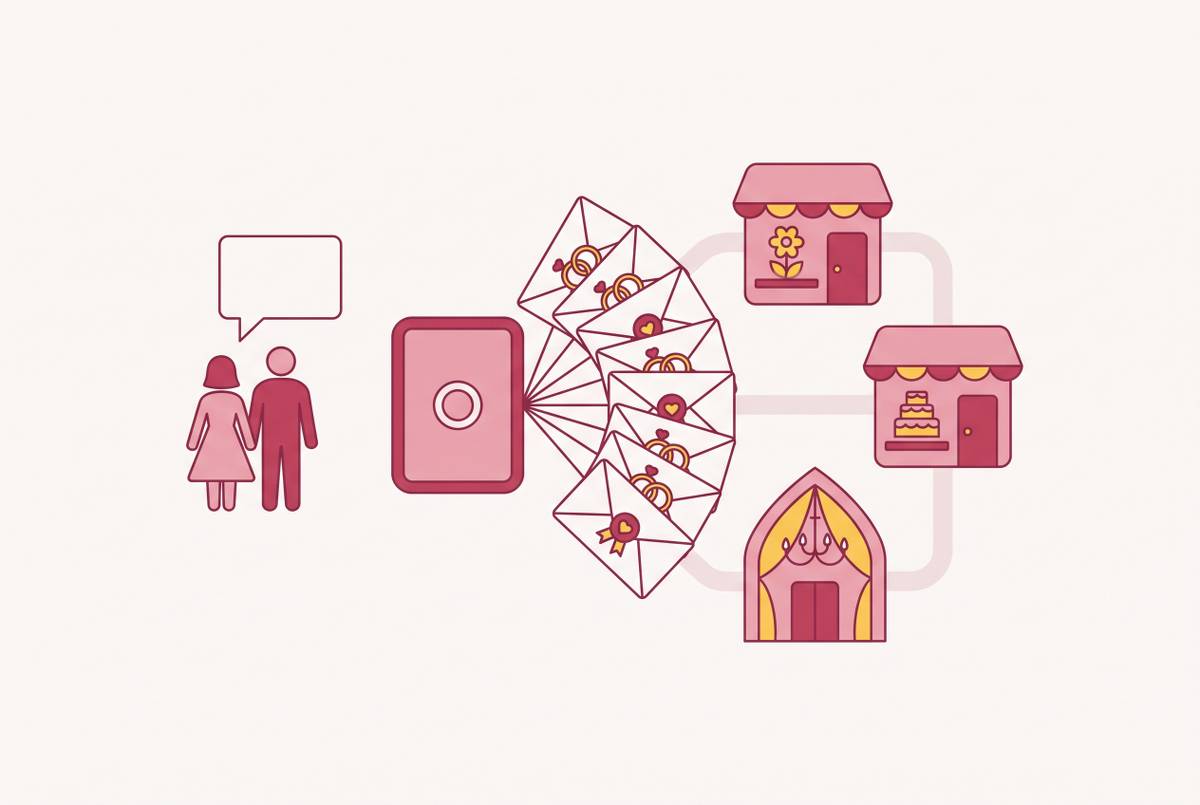
The chain has four links, beginning with a structured digital RSVP and a guest list with per-person dietary flags. The seating chart then inherits those flags automatically, and an export turns them into a per-table briefing for catering and floor staff. The seating chart adds where to serve the meal without anyone having to type the dietary answer again.
In a connected system, a change to a guest’s requirement at the RSVP stage passes through to the seating chart, table card and catering briefing without anyone typing it again. When the tools are separate, someone must find every place the old answer was copied and change it there too. The task is no longer simply recording the guest’s answer. It is maintaining agreement between documents that can drift apart.
The seating chart therefore has an operational role. It turns individual requirements into table-by-table instructions, so servers can identify which table, which seat and which restriction belong together. It also makes the distribution of dietary needs visible during seating planning. Grouping guests with dietary requirements can help servers find them efficiently, while scattering those flags across many tables creates more service complexity. The chart is not just a picture of where people will sit.
What the caterer and floor staff actually need on the night — and how the flow produces it
The person taking a plate to a table needs more than a total. “One vegan, two coeliacs, one halal” may describe meal quantities, but it does not tell floor staff where those meals belong. A usable briefing connects each guest’s name with their table number, dietary category and specific restrictions. The count supports preparation, while the individual rows support service. Staff should be able to do both jobs without having to remember which name was on another list.
Timing is part of that usefulness. Australian caterers in Sydney, Melbourne, Brisbane and Perth typically require final numbers one to two weeks before the event. The dietary briefing should be ready with those numbers rather than treated as a separate document to assemble afterward. Menu planning can require dietary information earlier still. A service-ready export is the final expression of that information.
Peppers Creek Barrel Room places the setting in concrete terms. The venue is in the Hunter Valley, where the same distinction between a seating layout and a dietary briefing applies. A chart can show where a guest sits, but the catering document must also show what that guest needs.
In the connected flow, the per-table briefing comes directly from the seating chart. The guest record built during planning becomes the document supplied to catering and venue staff, without a separate reformatting task. Its value is measured at the table. When the information is already connected and complete, there is no night-before or morning-of scramble to compile a briefing from cards, spreadsheets and messages.
The strongest objection: late RSVPs can still break the chain
A connected flow cannot move an answer that was never submitted. Late or incomplete RSVPs remain a real weakness, even when every technical link works as intended. A guest can have a place on the guest list without having supplied the dietary information needed for their meal. Treating missing input and reconciliation problems as interchangeable gives couples false confidence in what software can solve.
The earlier deadline is the one that counts here. Dietary requirements need to reach the caterer before the menu is finalised, with the brief’s planning range running from two to four weeks before the event. Two weeks is the low end and leaves little margin. That timing differs from the one-to-two-week window for final numbers because deciding what can be prepared and confirming how many people will attend are different tasks.
The practical response is specific human follow-up. A guest who has not replied by the final deadline needs to be asked about dietary requirements and whether they are coming. The couple still has to obtain the information and get it to the caterer in time for it to be used.
A connected guest list makes that work more targeted by flagging incomplete dietary sections. Instead of comparing a spreadsheet with a separate RSVP list, the couple can see which guests still need chasing. No platform removes the need for active follow-up, and automatic updates are not a substitute for a timely briefing. The honest promise is narrower and more useful than that. The system shows what still needs handling.
How to evaluate whether your planning tools actually form a connected chain
The most revealing test is a changed answer. If a guest updates a dietary requirement after the initial RSVP, that update should appear automatically in the seating chart and catering briefing. If someone must type it again, the chain contains a manual join. For couples evaluating tools, this test is more useful than treating the presence of an RSVP form and a seating feature as proof that the two share information.
The next test concerns the first transfer. A seating chart should know each guest’s dietary flag without an import or copy-and-paste step from the RSVP tool. Otherwise, that first move makes a separate copy of the information before anything has changed. The final test is the output. The platform needs to export a per-table, per-guest dietary briefing that a caterer can use, rather than leave the couple to build that document from seating-chart data.
These tests also sharpen the Australian buyer’s question. AUD pricing and Australian vendor support describe local suitability, but they do not establish whether a platform connects dietary answers to service. A tool can meet one set of needs without meeting the other. Likewise, separate RSVP and seating tools may each do their own jobs well and still leave someone to handle dietary reconciliation between them.
For couples already using separate tools, the lesson is to locate the exact join where dietary information is being re-entered. They can then consolidate into a connected platform or establish a deliberate handoff with a named person, a named document and a named deadline. That handoff still takes manual work, but puts a named person in charge so the task is less likely to be left to memory. That distinction keeps the promise honest. Reconciliation disappears only where the information no longer has to be separated and put back together.