Wedding Platforms That Email Vendors on Couples' Behalf Without Consent
Platforms profit from vendor access to couple data, raising consent concerns.
When wedding platforms email vendors on couples’ behalf, who gets to decide about that contact is less clear. Some tools turn planning activity into vendor leads, with consent that is less clear than it should be. For couples seeking wedding planning software with a one-time payment instead of a subscription, Wedbuild offers free access to start and optional one-time paid upgrades, without a vendor marketplace. The key comparison is who pays the platform and what that buys them.
How free-to-couple wedding platforms actually make their money
Browsing a wedding platform can feel free and useful. You can explore suppliers, enter a wedding date and start putting a budget together without paying for the tool. But most platforms that are free for couples are funded by vendor subscriptions. The planning tool is also a lead-generation engine for the businesses paying to be listed.
A wedding date, location, budget and guest count help vendors see whether they can meet the needs in an enquiry. Dietary preferences tell them more about the event. The same information that helps a couple plan can therefore help a supplier target its offer. This creates an incentive to route information out of a planning account.
A different source of revenue changes that incentive. Wedbuild is free to start, with couples choosing to pay only for features they actually use through optional upgrades. By forgoing revenue from couple data and vendor access to leads, it removes the financial reason to send personal information to paying suppliers in the first place. A funding model explains whose needs a platform is built to serve.
What "automated vendor outreach" actually means in practice
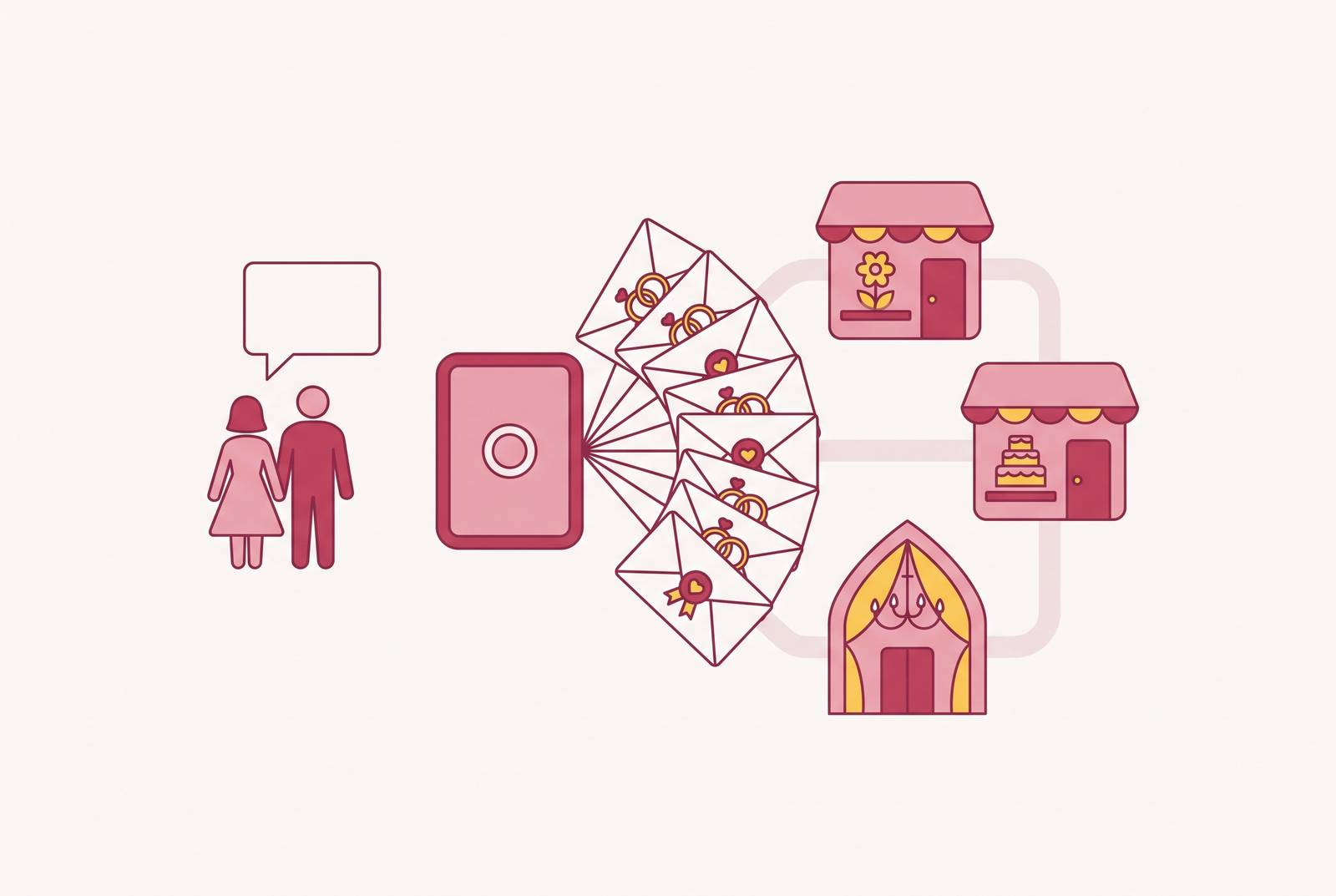
Automated outreach happens in two ways, and knowing the difference matters when an email arrives out of the blue. In the first, a platform shares information with a vendor after a couple submits an enquiry. The National Wedding Directory’s privacy policy, last updated March 2026, states, "When you submit an enquiry or message to a vendor, we share your contact information and enquiry details with that vendor". That is a disclosed handover linked to an explicit action. It is not, by itself, evidence that the platform sells personal data to third parties.
The second process happens on the vendor’s side. A customer relationship management tool, often shortened to CRM, can start an automated email sequence when a couple enters its system. Wedy Pro is a documented example of vendor-facing automation, rather than a reason to treat one provider as uniquely problematic. The important mechanism is the sequence that follows the initial contact. A couple may know they made an enquiry without knowing what will trigger follow-ups, how long they will go on or how many there will be.
That distinction also separates an email sent on a couple’s behalf from an automated reply sent to them. One initiates contact in their name, while the other acts on information a vendor has received. New AI-powered tools let vendors reach more people, with less human judgment about whom to contact each time. Responsibility depends on what action triggered the process, what information moved and what the couple agreed to.
The thin consent problem: what couples agree to without realising it
Even when a platform discloses contact, the permission buried in its terms is often broader than the action feels to the couple. Favouriting a vendor can feel like saving an idea. The ABIA model makes that contact consequence explicit, but disclosure does not make those two actions feel equivalent. The gap between a casual click and the contact it permits is where consent becomes thin.
Platforms that are less clear about this may rely on inferred consent. Australian law has yet to settle whether signing up to browse a directory gives vendors permission to make contact. Equally, an unwanted message is not automatically unlawful just because the couple did not expect it. Terms may authorise uses that the person never consciously considered. That can make the path to a legal remedy less straightforward than the irritation in the inbox suggests.
Budgets, guest lists, addresses and wedding dates describe both the couple and other people attending the event. When a tool such as Wedbuild links guest lists, dietary requirements, seating arrangements and other planning information, it is especially important to be clear about how that data is used. The tool still needs to explain that use even when the data stays within its planning flow. The more connected the system, the more clearly couples need to see what they are authorising.
ABIA explicitly prohibits vendors from using "a bot or any other automated service to communicate with prospective engaged couples" on its platform. That is a voluntary standard. It shows that the industry can distinguish between having a route to contact someone and allowing every available method of contact.
What Australian law actually requires — and where it stops
The Spam Act 2003 (Cth) places a real consent requirement on commercial electronic messages. Section 16(1) prohibits sending, or causing to be sent, a commercial electronic message with an Australian link that is not a designated commercial electronic message. Sections 16(2)–(4) provide exceptions, including where "the relevant electronic account-holder consented to the sending of the message". They also cover lack of knowledge of the Australian link and messages sent by mistake. Automation does not create a separate exemption.
Consent under Australian spam rules can be express or inferred. Express consent is clearly given, while inferred consent comes from the relationship and the purpose for which someone supplied their email address. An enquiry gives a vendor a reason to respond, but it does not settle the scope of every later message. Scheduled Day 3 and Day 7 follow-ups may be far beyond what the couple understood when they clicked "enquire".
Sending multiple unsolicited emails without proper consent can lead to large fines for each day they are sent. That is meaningful protection, although complaints and enforcement action matter to making it effective. The Privacy Act 1988 also governs personal information handling, with APP 11.2 addressing destruction or de-identification when information is no longer needed, subject to its requirements. These protections address different parts of the problem. Permission to send a message and permission to retain or disclose the underlying data are not the same question.
The draft Privacy Amendment (Personal Data Protection) Bill 2026 would make further changes. Its draft APP 7 keeps a carve-out for messages already covered by the Spam Act, while the proposed fair and reasonable test and trading consent requirements still apply to how the data behind those messages is handled. The practical gap remains the distance between a legally supportable inference and what a couple actually expected.
The strongest case for automated outreach — and why it doesn't fully hold
The strongest argument for automation is speed, and it deserves a fair hearing. Couples now expect responses in minutes. A solo vendor may not be able to meet that expectation while doing the work couples want to book. AI-powered inbox tools can make a quick response realistic. An immediate acknowledgment can therefore serve the couple as well as the business.
There is also a meaningful difference between responding to an enquiry and contacting someone cold. Automation advocates are right that the couple often initiated the first action. A system that promptly acknowledges that action is not inherently overstepping. The problem begins when that narrow justification is used to defend a much longer sequence. Starting a conversation does not settle how long it should continue or which channels it should use.
An acknowledgment is different from a "Day 3 value touchpoint" followed by a "Day 7 channel-switch reminder". Those steps turn a response into a programme of pursuit, which the couple may never have understood they were entering. The objection therefore concerns scope and persistence. Automated outreach at scale can also depress response-rate data, making genuine interest harder for vendors to read. More contact is not necessarily better service for either side.
How to read a wedding platform's privacy policy before you sign up
A useful privacy check does not need to become a second planning project. Who funds the platform helps explain what the policy permits. Vendor subscriptions give platforms a reason to bring in leads, while an ad-free, couple-funded or one-off-payment model has no such reason. For couples looking to buy a wedding planner once rather than pay monthly, payment frequency is one criterion. The data-sharing terms still matter.
First, look for the event that allows contact details to leave your account. Sharing only when you explicitly enquire is narrower than sharing because you signed up or showed interest. The National Wedding Directory’s wording gives a concrete example of an enquiry-based handover. A useful policy ties “sharing” to an action you recognise as a request for contact.
Second, check what browsing and favouriting mean. A saved vendor may stay private in the couple’s plan, or the platform may take it as permission to make contact. ABIA makes it clear that saving a vendor allows contact, so couples can weigh that up.
Third, look for how long information is retained after the wedding and whether it can pass to advertisers or third-party lists. Fourth, check whether you can unsubscribe from each vendor separately or only opt out of the platform’s own messages. These checks concern what happens after the initial handover, when the platform and vendor may be acting separately. A platform-level setting is not a clear answer unless the policy explains the scope of that setting.
PlannedBy, built by BAV Studios Pty Ltd, states that directory entries and notes are "private to the account that created them. One planner cannot see another planner's directory." That is a specific promise about visibility. Read claims at that level of precision. A useful policy says what stays private, what moves and what action permits it.
What a planning tool built the other way looks like
An alternative model starts with tools for the couple. Guest lists, seating charts, budget trackers and digital invitations can work without passing leads to suppliers. Vendor comparison can also stay under the couple’s control when it uses information about businesses they have already found. There is no paying vendor audience waiting for that information.
For example, there is no vendor directory in Wedbuild. Its vendor comparison tool helps couples evaluate suppliers they have found themselves, with the information kept within their account. It links the tools so that RSVP responses update the guest list, which feeds the seating chart. The seating tools then support printed table cards with dietary legends and a QR-code seat finder for guests on the day. Those connections use personal information to carry out the couple’s plan.
The payment model follows the same distinction. Wedbuild offers a free starting point and optional paid upgrades, with every couple plan structured as a one-time payment. That makes it an option for couples seeking wedding planning software they can buy without a monthly bill. It does not make price a substitute for reading the privacy terms.
Couples do not need to assume every free tool is a trap or every automated response is unwanted. They need to distinguish useful automation from contact that outruns the permission behind it. The question to ask before signing up is whether the platform’s revenue depends on vendors knowing about you. Once that dependency is visible, the choice becomes clearer. A planning tool should help you organise the wedding and make clear who has been invited into your inbox.