The Real Cost of a Perth Wedding Compared to Eastern States
Perth couples should budget below national averages to match their actual market.
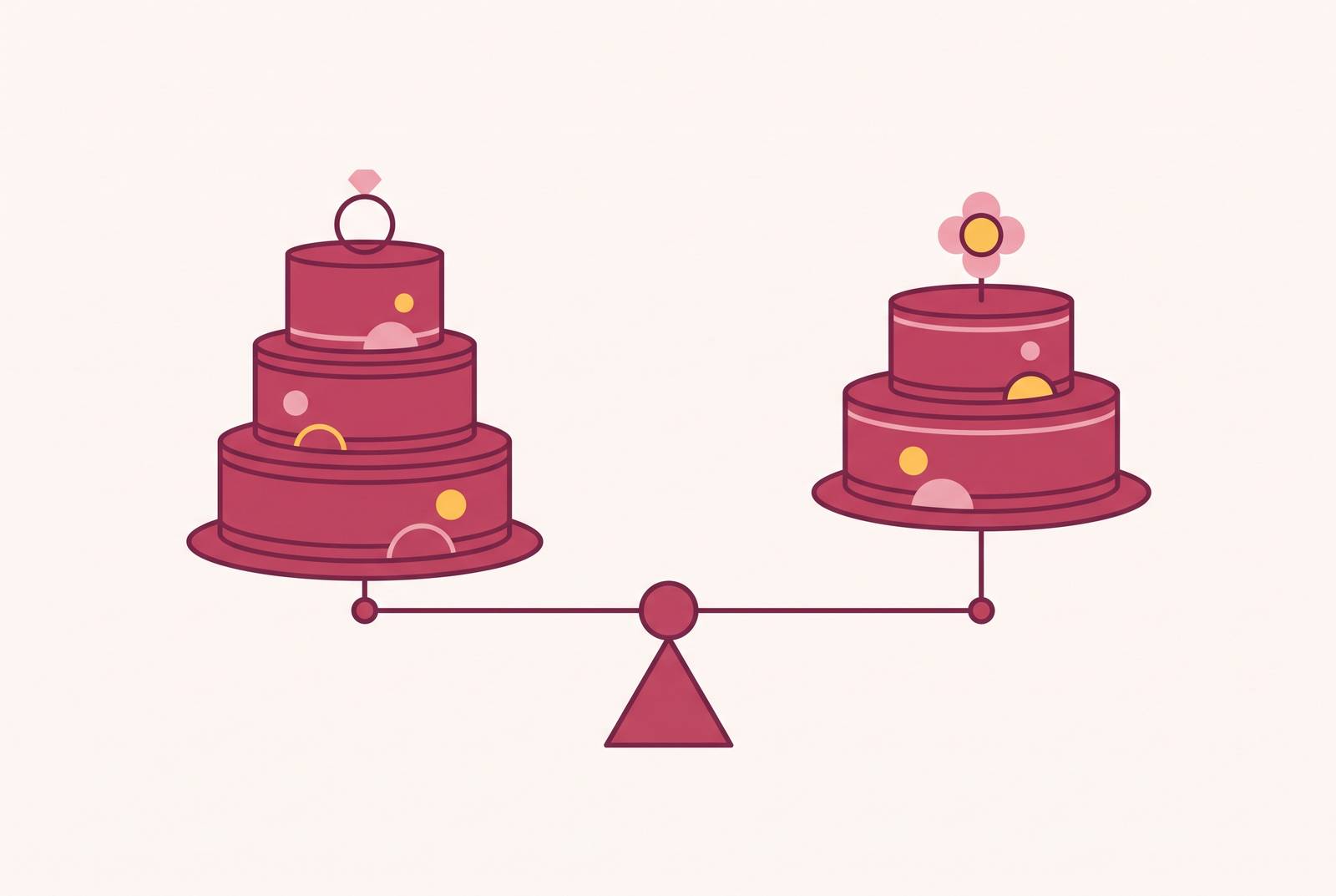
When a Perth couple opens a national wedding cost survey, they find a benchmark figure and start budgeting against it. That number almost never matches what local vendors actually quote, and the gap is not a sign of bad luck or poor shopping. Two widely cited survey figures already disagree with each other: one tracks average final spend, another from ABIA's survey of couples lands considerably higher, because the two measure different groups of couples and bundle different costs together. Neither figure is wrong. Neither one describes Perth, either. NSW averages sit highest among the eastern capitals and drag the national number up with them, while WA sits meaningfully below the national midpoint. A Perth couple who budgets to a "national average" is, in practice, budgeting to an eastern-states number, and ends up either overspending their real ceiling or padding a budget with headroom it never needed.
The structural reasons Perth venues and catering cost less than Sydney and Melbourne
Perth venues and catering cost less than their Sydney and Melbourne counterparts, and the reason has nothing to do with couples settling for less. Wages, venue supply, and demand in this regional market set a different market floor from the one in place on the east coast. That matters because venue and catering together make up nearly half of a typical wedding budget, so the category where Perth's advantage runs deepest is also the category that moves the total the most.
The numbers show the gap directly. Perth venue hire for a 100-guest reception averages around $121 per head. Sydney's premium tier, especially harbourside venues on a peak Saturday, runs well above that per head. Catering follows the same logic: hospitality wages in Sydney and Melbourne run higher, demand for Saturday dates is more concentrated, and caterers price to match both pressures. Perth simply doesn't carry the same wage base or the same crush of demand on a handful of dates.
Some couples hear "cheaper" and assume it means a smaller, weaker vendor pool or a drop in quality. That assumption doesn't hold up. Perth's vendor community is smaller than Sydney's or Melbourne's, but it's competitive within its own tier, and the price difference reflects input costs, not a quality discount. A couple who books a Perth caterer is paying a price shaped by a labour market and a venue supply that simply looks different from the east coast, not trading taste or service for savings.
Photography and celebrant markets in Perth versus eastern capitals
The same structural pattern appears in photography, though not in every category a couple researches. Perth photographers charge across a wide range, and the average couple spends around $4,000, below the national average for comparable coverage. The reason tracks with the venue and catering story: lower operating costs in WA support a lower floor price. That doesn't mean the ceiling drops too. Perth's photographer market is smaller than Sydney's, but it still has genuinely skilled operators who charge premium rates for premium work. A couple chasing a top-tier shooter in Perth will still pay a serious price. A couple looking for solid, reliable coverage will find it for less than they would on the east coast.
Celebrants tell a different story. The gap between an outstanding celebrant and an average one is a fairly small dollar amount in any city, Perth included. This is not a category where Perth couples gain much ground relative to Sydney couples.
Floristry and regional vendor travel
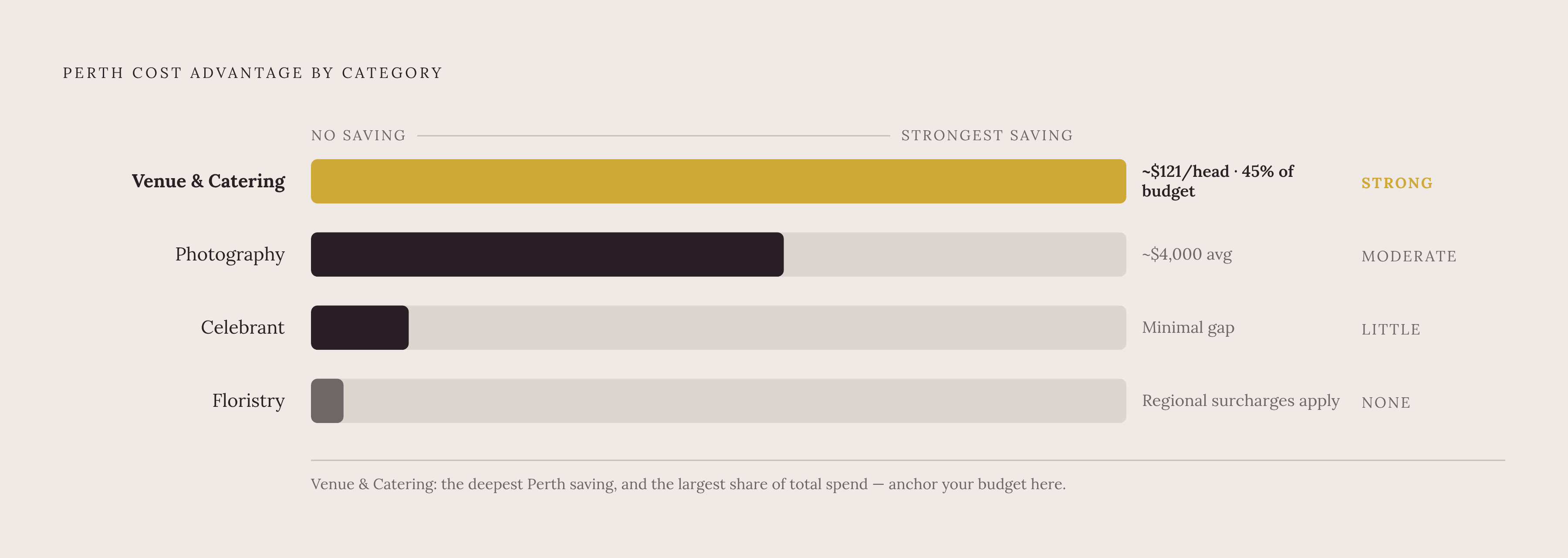
Floristry breaks the pattern. Perth's florist market runs above the national average on some packages, so if a couple books a venue in Swan Valley or Margaret River, travel surcharges eat into the savings those regional venues otherwise offer. Knowing this ahead of time keeps a couple from getting blindsided mid-planning.
The surcharge logic extends past flowers. When couples source specialty food products, furniture, and styling items from interstate or overseas, freight and fuel costs land on their invoice. A dry-hire wedding in Swan Valley or Margaret River that leans on imported or specialty elements will feel this directly. Vendor travel adds its own line item too: a photographer, caterer, or stylist travelling from Perth metro to Yallingup or Margaret River typically charges a travel fee, and that fee chips away at the venue savings that drew the couple to a regional location. A marquee wedding in Yallingup with full styling and live entertainment can still reach well into the tens of thousands once every vendor on that list is booked. Perth's regional tier isn't automatically the budget option once a couple stops cutting corners on styling.
The honest version of the Perth cost story draws a clear line. Venue hire, catering, and photography are categories where the structural advantage is strong and dependable. Floristry is a category where a couple should get a local quote rather than assume the national average, or any instinct about Perth being cheaper everywhere, applies downward.
Why Perth couples are not immune to overspend
Starting from a lower market floor doesn't protect a Perth couple from finishing over budget. The mechanisms that push any couple past their original number operate the same way in Perth as they do in Sydney or Melbourne. ABIA's survey of couples puts the average overrun at a notable margin and recommends building a financial buffer into the starting budget by holding back a real share of the total.
The causes repeat across every city. Hidden fees appear that nobody quoted at the start: corkage, overtime charges, meals for suppliers. Guest lists grow past the original plan. Couples get deep into planning, get emotionally attached to an upgrade, and say yes to it. Guest count sits above all of these as the single strongest lever in any city, because venue, catering, invitations, and favours all scale per head. Adding or cutting a handful of guests moves the total by thousands of dollars.
A Perth couple who starts with a structural price advantage and then lets the budget run over plan gives up much of that edge. They can end up spending close to what a disciplined Melbourne couple spends, one who started from a higher number but held the line on it. The advantage Perth offers isn't automatic. It has to be protected through the planning process. Budget tracking becomes less of a nice-to-have and more of a requirement.
Off-peak timing and guest count adjustments that compound Perth's structural savings
Perth couples have levers beyond the market floor itself, and pulling them adds further savings on top of what the floor already provides. Timing is the clearest one. Sunday and weekday bookings cut venue hire by a meaningful amount in most cities, with Emu Money finding savings of 20 to 30 percent compared to Saturday peak pricing. In Perth, this stacks with a second effect: regional venues in Swan Valley and Margaret River see lower demand outside the spring and autumn peak, which pushes prices down further in the off-peak months of May through August. Ceremony-only packages in that window can land at price points that would be out of reach at a Sydney waterfront venue on any date.
Timing with the season isn't the only factor working in Perth's favour. Gen Z now makes up the majority of engaged couples in 2026, and this group shows a clear preference for outdoor, landscape-led ceremonies. Western Australia's coastline, its wide range of wildflower species, and its wine regions line up directly with what the largest group of currently engaged couples is actually looking for. A coastal sundown ceremony at Cottesloe Civic Centre, with a moderate guest count and a long-table dinner, can come in well below the cost of a full marquee wedding in Yallingup with styling and live entertainment. That range, from one end to the other, shows both the floor Perth can offer and the ceiling it's still capable of reaching.
Guest count remains the strongest lever no matter where a couple holds the wedding, but in Perth, cutting the list delivers savings that are proportionally real rather than symbolic, since per-head costs across catering and venue hire start from a lower base. One more factor supports off-peak timing as a strategy: Australia recorded well over a hundred thousand marriages in 2024, up from the year before. More couples are competing for the same peak Saturdays and the same in-demand vendors, which keeps pricing firm on those dates. Negotiating on a Saturday in peak season is a harder path to savings than simply choosing a different date.
Building a Perth wedding budget category by category
A realistic Perth budget gets built from the ground up, category by category, using Perth pricing as the reference point rather than adjusting a national figure downward and hoping the adjustment is close enough. Built this way, the total lands materially below the national benchmark, for reasons a couple can point to.
Photography takes up roughly a tenth of a typical total budget. Perth's floor is below Sydney's, so couples spend across a wide range, and the average is somewhere in the middle of that range. A mid-to-upper Perth package is a sensible reference point for couples who want solid, dependable coverage without chasing the top of the market.
Floristry needs its own local quote. Native species common in WA keep costs down, but imported European varieties carry a freight premium specific to this state. If a couple assumes the national average applies here, and applies it downward, they risk a budget line that's wrong in either direction.
Entertainment, cake, stationery, and transport broadly track the national mid-range in Perth, so the national average cost breakdown works fine as a guide for these smaller items. They don't carry the same structural gap that venue, catering, and photography do, so there's no need to adjust them heavily in either direction.
Contingency belongs in every Perth budget regardless of how tight the planning looks on paper. The overrun mechanisms, hidden fees, overtime, supplier meals, guest list creep, apply in Perth exactly as they do everywhere else, so a real buffer above the primary spend total protects against them.
Family contributions remain part of the funding picture for most Australian couples: a large majority receive financial help from family. An early, direct conversation about who's contributing and how much keeps the full picture clear before deposits go down. Building a realistic Perth budget starts with state-level data instead of a national figure, and then it holds to actual spend category by category, so decisions about venue, catering, and every other line item reflect Perth's market. A platform that ties guest count, venue choice, and catering decisions to one shared budget view makes it easier to see how a change in one category ripples through the rest of the plan, which keeps a couple anchored to Perth numbers. Because venue and catering together make up nearly half of any wedding budget, getting a firm handle on Perth's advantage in those two categories is where a couple gains the most control over the total. A budget planner that lets a couple test different per-head venue and catering costs in real time, and watch the effect on the total immediately, shortens the path to realistic Perth figures instead of starting from a national number and guessing how far to pull it down.
How a connected planning tool protects Perth's structural savings
Perth's structural savings hold up best when every piece of planning data, guest count, per-head costs, dietary needs, vendor quotes, lives in one connected system instead of scattered across spreadsheets, email threads, and text messages. The categories where Perth couples carry the most risk, hidden fees, supplier meal requirements, overtime clauses, a final headcount that confirms the catering guarantee, are exactly the categories that depend on tracking RSVPs, dietary needs, and vendor contract terms together.
Timing makes this concrete. Formal invitations typically go out six to eight weeks before the wedding, with an RSVP cut-off roughly three to four weeks out. The final headcount pulled from those RSVPs drives the catering guarantee, the seating plan, and the final invoices all at once. If you track those pieces in separate places, small errors compound into real costs by the time final invoices arrive.
WedBuild connects a couple's guest list, RSVPs, dietary requirements, seating chart, vendor comparison, and budget planner into a single flow, so when a guest RSVPs with a dietary requirement, it moves straight onto the seating chart without someone manually cross-checking a spreadsheet the morning of the wedding. Tracking regional vendor travel surcharges and specialty product costs alongside venue savings calls for the same kind of itemised visibility, particularly for couples booking Swan Valley or Margaret River venues where travel costs accumulate fast. When you see each line item's effect on the total budget in one place, an apparent venue saving can't get quietly cancelled out by logistics costs nobody noticed until the final invoice arrived. Perth's cost advantage is real and well documented. Keeping it intact through months of planning is a matter of tracking the details as carefully as the market rewards couples who get the big categories right.