Why Wedding Budget Overruns Happen at Predictable Points
Threshold costs and guest-list changes trigger multiple hidden charges at predictable moments.
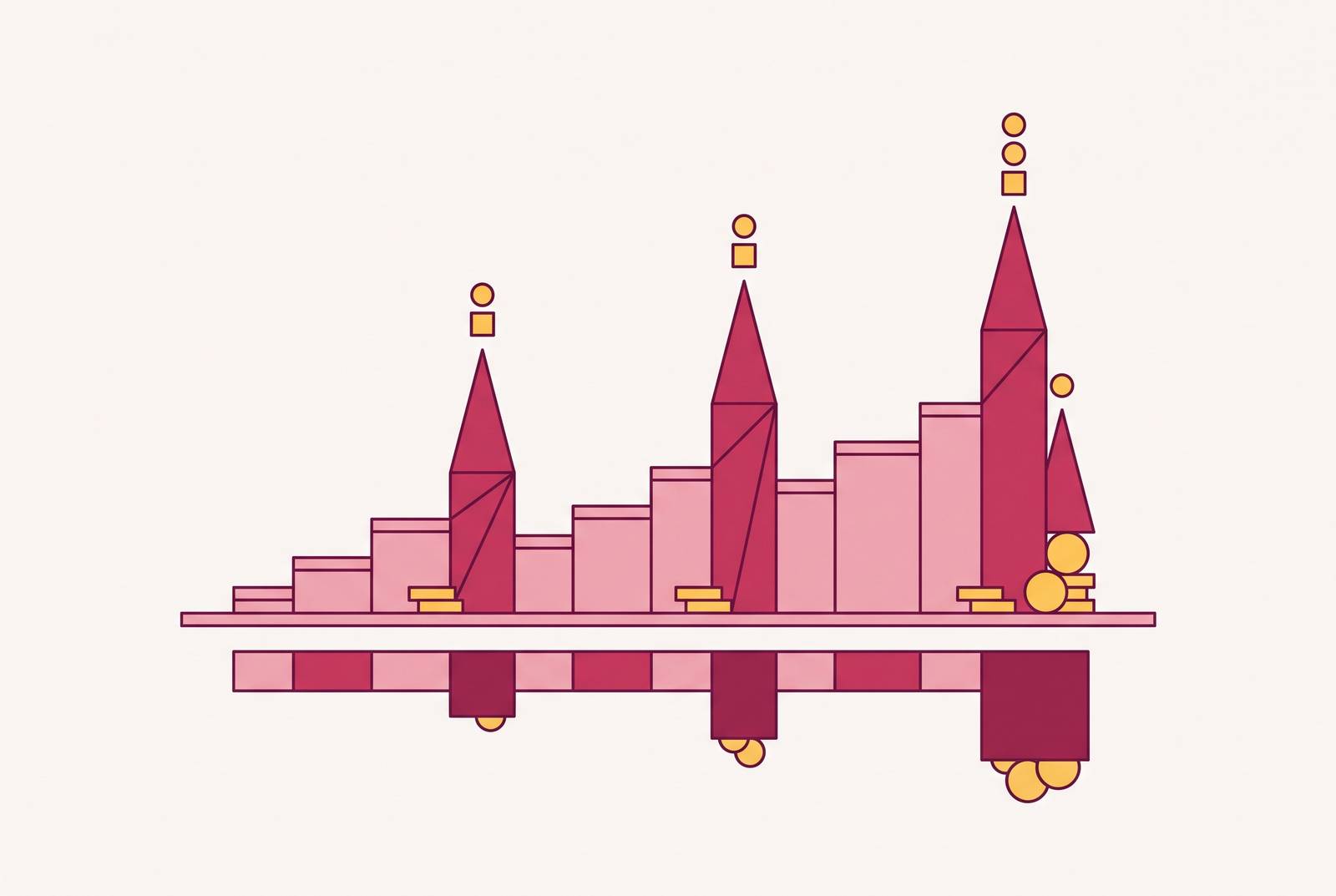
Most couples start planning with a single number in mind, borrowed from a national average, and that number is already working against them. Averages blend restaurant receptions, private estate weddings, regional hall bookings, and large premium events into one figure, so no individual couple's wedding actually resembles the blend. The more dangerous gap sits elsewhere: the average original budget couples set is meaningfully lower than what those same couples actually spend. That gap, between the number couples plan around and the number they eventually pay, is the overrun this piece is about.
The gap is a design problem, built into how wedding costs are structured.
Three cost types sit inside every wedding budget, and most couples treat them as if they were one. Fixed costs, like photography, the celebrant, entertainment, and core attire, stay the same regardless of how many guests show up. Per-person costs, like food, beverages, furniture, and transport, scale directly with every name added to the list, while stationery scales partway, since it's billed per household rather than per person. Threshold costs behave differently still: they sit flat until a guest count crosses into a bigger room, requires extra staff, calls for another bus, or mandates an assistant coordinator, and they stay invisible in most budgeting approaches until the moment they hit.
Budgeting as though every line item is fixed makes the plan feel stable right up until it isn't. Guests get added because they feel cheap to add, but once you cross a threshold, several costs jump at once. The venue contract is where that first crack in the plan appears earliest and most visibly.
Venue contracts and the first, largest concentration of hidden costs
No signature in the whole planning process carries more risk than the venue contract. It locks in a pricing structure that shapes nearly every other cost for the rest of planning, and most couples evaluate it only on the headline fee printed at the top of the quote.
Two venue pricing models produce very different totals, and couples routinely underestimate the final cost of the one that looks cheaper at first glance. Dry-hire venues rent the space alone, with catering, drinks, furniture, and styling booked separately through outside vendors. The headline fee looks low, but it can hide a high final total once you add those suppliers one by one. Minimum spend venues sit between dry-hire and all-inclusive: clear the spend figure with the guest count booked and the room is effectively free, but fall short of that figure and the shortfall gets charged anyway. Venues with exclusive or preferred caterers charge premium rates, and restrictions on outside photographers, florists, or entertainment strip away a couple's ability to shop competitively. The contract terms end up setting the price instead of the open vendor market.
Several secondary charges appear only after the contract is signed, in categories the initial sales conversation rarely covers. Corkage fees apply when couples bring their own beverages instead of buying through the venue. Cake-cutting service charges apply even when the cake itself was bought elsewhere. If setup or the celebration runs past the contracted hours, overtime charges kick in. Supplier meals, covering photographers, coordinators, and musicians working the event, often get billed as a separate line.
A short list of questions, asked before signing rather than after, uncovers most of this before it becomes a surprise: What guest count or quantity is the quote based on? Are staffing, travel, delivery, setup, and pack-down included in the fee, or billed separately? What triggers overtime or extra staffing charges? Is GST included in the number on the page? What is non-refundable, and what can still change after the contract is signed?
The guest count entered on that contract is a starting estimate. The next overrun begins the moment that estimate starts moving.
The guest list revision as the most expensive decision after the venue is booked
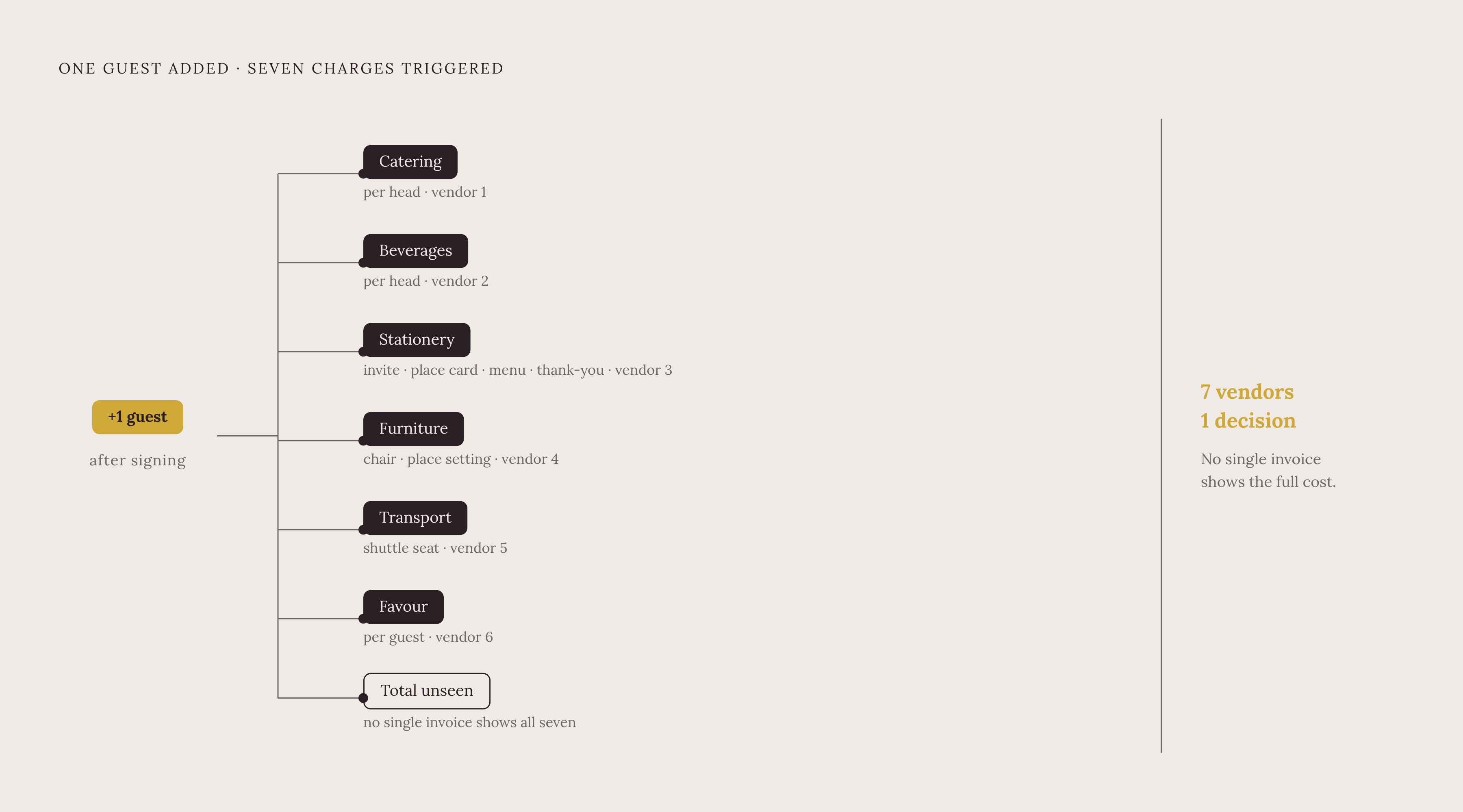
Once you sign the venue contract, the most expensive decision you have left is how the guest list changes afterward. The contract locked in a pricing structure built around an estimated headcount, and every guest added past that point pulls on multiple cost categories at once, not just one. Most couples experience this as painless, because the cost of each addition gets spread thin across categories instead of landing as one visible charge.
Adding a name to the list after the venue is booked feels like a small, low-stakes decision, but it isn't. Each additional guest adds a catering cost per head, a beverage cost per head, a stationery unit covering an invitation, place card, menu, and eventual thank-you note, a furniture unit covering a chair and possibly a table place setting, a transport seat where shuttle or bus hire is involved, and potentially a favour. One name on a list quietly turns into six or seven separate costs spread across six or seven separate vendors, and none of them show the couple the full weight of that single addition in one place.
Threshold effects make this worse. Guest additions don't scale in a straight line. At certain counts, the venue requires a bigger room, an extra bus becomes necessary, or the venue's own contract mandates another staff member, so the cost of one additional guest at that threshold can run many times higher than the cost of the guest added just before them. The argument here isn't that couples should invite fewer people, and it isn't a case for trimming the list. The argument is that adding guests is a structural trigger for overrun, one that needs a tool capable of cascading that single change across every affected category automatically, rather than a single edit on a spreadsheet that only updates one cell.
The guest count that matters most is the number confirmed at RSVP close, a separate planning moment with its own cascade of consequences.
The RSVP-to-catering cascade and the three-month sprint's second wave of adjustments
Around the three-month mark before the wedding, RSVP tracking and final count confirmation set off a cascade of dependent decisions that all land at once. The sequence itself forces this collision: a change in one part of the plan forces a change in everything downstream of it, all inside a compressed window.
The dependency chain runs in a fixed order. Final caterer numbers trigger an invoice adjustment, with the per-head rate applied against the confirmed count, a number that may differ meaningfully from the estimate the venue contract was built on months earlier. Stationery has to follow in sequence too: the confirmed guest count drives place cards, menus, and the seating chart, and each of those has to be finalized after the one before it, with its own separate production lead time stacking on top. Dietary requirements collected through RSVPs need to be reconciled against the seating chart and then communicated to the caterer. When those two things live in separate systems, manual reconciliation on the morning of the wedding becomes the fallback plan, and that is where errors creep in most often. Furniture and linen hire quantities need confirming against the final numbers as well, on the same compressed timeline.
Stationery and signage quietly become one of the most consistent stealth costs in this phase. Invitations, RSVP cards, signage, menus, place cards, seating charts, and thank-you notes all draw on design and printing budgets that accumulate fast, especially with custom options, and every one of them depends on a guest number that isn't locked in until late in the process. The overrun mechanism here is sequencing under time pressure: decisions that should be spread across weeks get compressed into days, and rushed decisions made under that kind of pressure default to "yes" on add-ons simply because the wedding date is close enough that renegotiating feels riskier than paying.
The final month stacks even more on top of this. Styling, furniture hire quantities, and timings with every external supplier all get confirmed at once, most payments fall due in this same window, and dietary requirements get finalized with the caterer on the same compressed schedule. Any error sitting in the RSVP data from weeks earlier becomes visible now, at the point in the process with the least room to absorb it.
How vendor add-on conversations produce a yes
Vendor meetings, particularly floral consultations, photography briefings, and cake tastings, are built environments, and they're built to produce agreement. Add-ons tend to get presented after a couple is already emotionally invested in the vendor and the vision, which makes each incremental cost feel small set against everything already committed.
Floral consultations are the clearest example of this pattern in action. Couples routinely walk in holding Pinterest boards full of large-scale floral installations, exotic out-of-season blooms, and luxe arrangements pulled from weddings shot in a different season. A florist writing for the industry blog A Petal to Peddle notes that these images "feature large scale installations of flowers and greenery, stunning bouquets with exotic flowers, and luxe scenes from weddings across seasons," and warns that "dreaming of flowers that are out of season can lead to inflated costs." Florists quoted elsewhere in the industry echo the same warning: the gap between what a couple imagines walking in and what those images actually cost to produce is typically large, which makes florals one of the highest-overrun categories in the entire budget.
The same mechanism drives every vendor meeting, not just floral consultations. Once a couple sits down inside the meeting, a reference point has already been set, usually the original budget or the vendor's starting quote, and every add-on gets presented as a small departure from that reference point rather than as a percentage of whatever budget remains. A single addition feels minor because it's being measured against the cost of the item itself, not against the pattern of additions building up behind it. Photography runs on the same structure: the day rate quoted at first contact is a starting point, not a ceiling, with second shooters, extended coverage, albums, prints, and engagement sessions each priced separately and each pitched at its own distinct decision point in the relationship.
Breaking that reference-point trap takes one habit: evaluating every add-on against what's left in the total budget, not against the price tag of the add-on in isolation. That's the same scrutiny a couple applied when choosing the vendor in the first place, applied again to every decision made after the first signature. You can't treat tracking committed amounts separately from amounts actually paid as a one-time setup task. It's a habit that has to hold for the full length of planning, and that continuity is where the right kind of system matters.
What an intercepting system looks like
Four moments produce almost all of the overrun this piece has traced: the venue contract, the guest count revision, the RSVP-to-catering cascade, and the vendor add-on conversation. All four share one structural feature. A decision made in one area stays invisible to whatever system is tracking a different area, and the gap between those two blind spots is exactly where the money leaks out.
Fragmented planning tools don't fix this. They recreate it. A budget tracker that doesn't update automatically when a guest gets added can't show the per-head cascade hitting catering, beverages, stationery, furniture, and transport all at once. An RSVP tool that isn't connected to the seating chart leaves dietary requirements to be reconciled by hand, usually under time pressure, with errors as the predictable result. If a seating chart isn't linked to the caterer's headcount, that final number has to be communicated manually, through a phone call or an email, instead of flowing through automatically. Separate tools for the guest list, the budget, and vendor comparisons mean a decision made in one system simply doesn't register in the others, so nothing in the stack actually sees the whole wedding at once.
An intercepting system works differently: it's built so that one update, a guest added, an RSVP confirmed, an add-on approved, moves through every connected category automatically, the same way the real cost of that decision does. The four overrun moments this piece has traced don't happen as random accidents scattered through a long planning calendar. They're predictable, they happen in the same order for nearly every couple, and a system built to catch the cascade at each one is what actually closes the gap between the number a couple sets out with and the number they end up paying.