Blended Family Seating Politics at Australian Weddings
Seat by emotional closeness, not biology or family politics, to sidestep blended family drama.
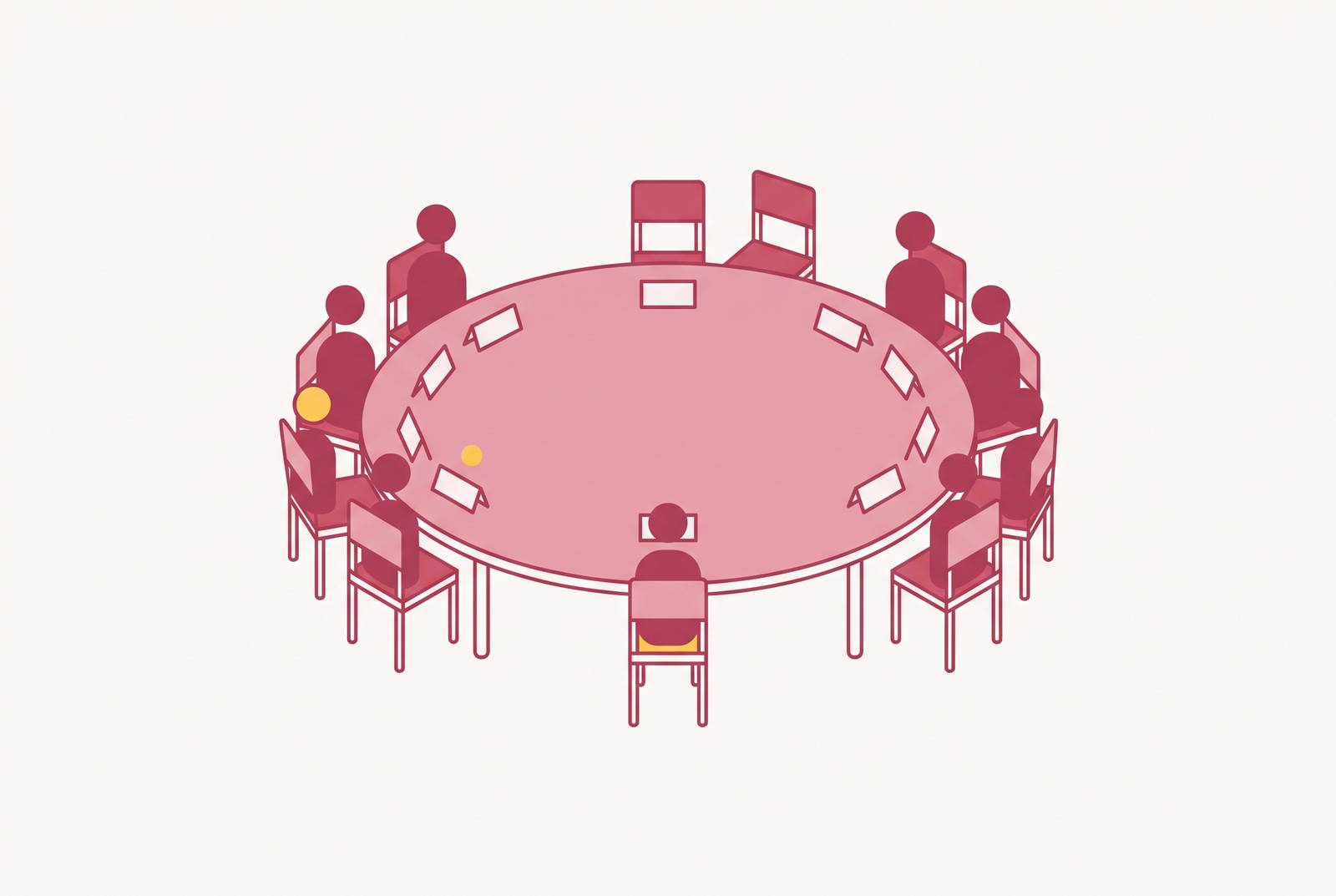
One rule handles almost every hard call: the closer someone is to the couple emotionally, the closer they sit physically. Not who's owed a favor. Not who holds the most sway in family politics. Just proximity to the couple, full stop.
For a blended family, that means biological parents sit close. So does a step-parent who actually did the raising, and a step-sibling who's been around for fifteen years. A parent's new partner of eight months sits further back. So does a step-relative the couple has met twice, or an ex-partner now attached to someone else in the family tree. Biology doesn't get a vote here. Time and involvement do, and that distinction is the whole rule.
Most couples get this backwards. They start from bloodlines, then try to patch the awkward spots with diplomacy, a neutral table here, a buffer seat there. That's the wrong order of operations. Planning around relationship rather than biology keeps most of the "diplomacy" problems from surfacing.
The rule also protects the couple socially. "We seated people by how close they are to us" is a fact about the couple's own relationships. Nobody can argue with it the way they'd argue about old scorekeeping, because there's nothing to score.
Agree on this map together, before either partner touches a chart. If one partner thinks a step-parent belongs at the front table and the other doesn't, that disagreement needs to happen in a quiet planning conversation, not get discovered by a guest reading a table number on the day.
The hardest case is the estranged biological parent seated near the step-parent who actually raised someone. Most couples flinch here and try to split the difference with some neutral middle placement. Don't. The rule still holds: seat by relationship, not biology, even when that reads as a statement to people watching. It is a statement. That's fine.
Rethinking ceremony sides when there is no clean "bride's side" or "groom's side"
Two sides, aisle down the middle, assumes each half of the room is a tidy, self-contained family. Blended families rarely sort that cleanly. A guest might be close to both people getting married, or related to one and estranged from someone sitting on their assigned side.
Open seating solves this by removing the split. Guests choose where they sit, no assignment, no side. It's increasingly common at Australian ceremonies, and it does more than fix a logistics problem: it tells every guest, before the vows even start, that the day is framed around unity rather than division.
Circle or mixed-layout seating pushes that further. Instead of two blocks facing off across an aisle, guests sit as one group witnessing the same thing together. It works especially well outdoors, or in a venue that isn't built around a traditional church-style aisle.
Same-sex ceremonies have mostly landed on open seating already, or a soft version where guests get guided toward whichever partner they feel closer to. That's a useful model for any couple juggling a complicated family structure, blended or not.
Small wording choices carry real weight here. A sign reading "please sit wherever you feel most at home" or "choose a seat, not a side" does more work than it looks like it should. If ushers are involved, brief them properly: they need to know the open-seating policy is deliberate, and they need a heads-up on any guest who might require quiet, specific guidance to a seat. Don't leave that to improvisation on the day.
Co-parents both attending needs its own small plan too. A nod during the welcome, a line in the celebrant's script that acknowledges both parents without turning it into a formal moment. Settle the wording in advance so nobody is caught improvising in front of a hundred people.
Grouping blended family units at the reception without creating fault lines
Give each family group its own table, with real boundaries between groups. That's the principle Australian planning guidance keeps landing on for complex family situations, and it's a gesture of care. It's a home base. Everyone needs one spot in the room where they're not managing anyone else's feelings.
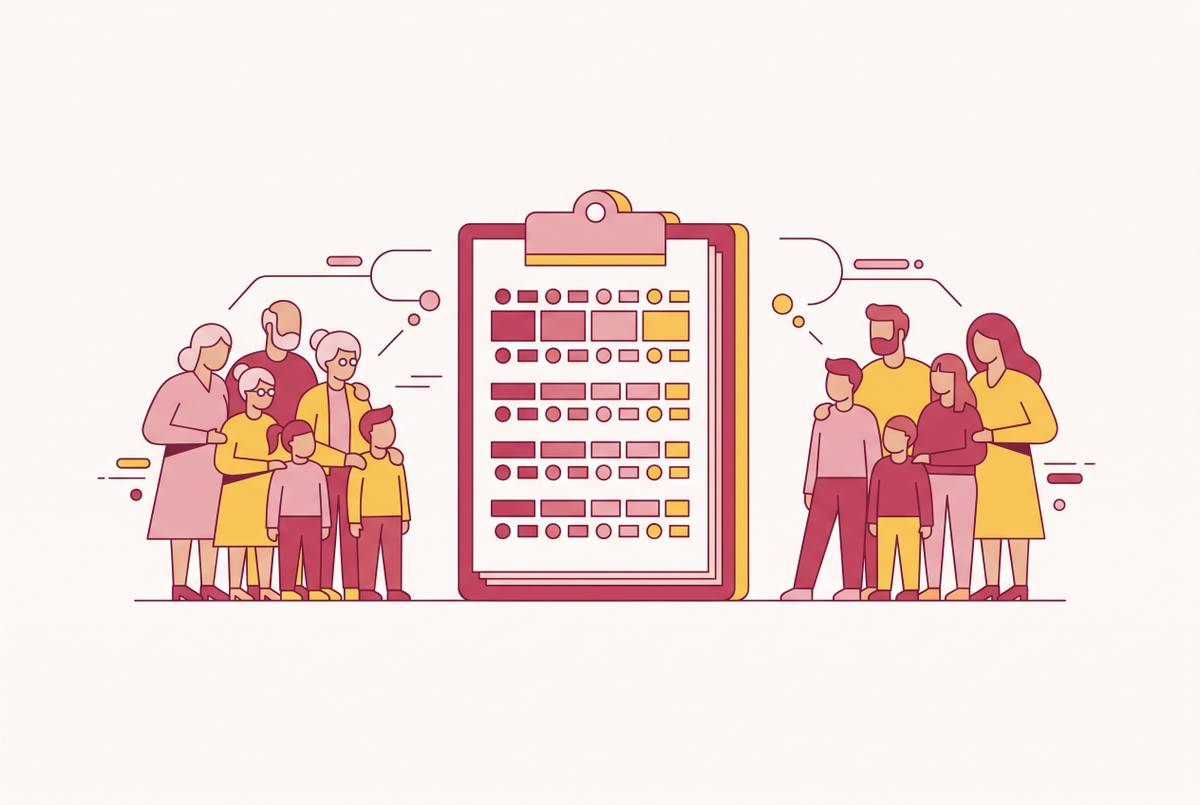
A family group means the household unit, the people who function as a family day to day. A parent, their new partner, and the kids they share can be one table, even with zero blood relation running through it. That's the actual unit that needs to sit together, because that's how they already operate outside the wedding.
When two family groups carry real history, a buffer table earns its keep. Seat a cluster of easygoing mutual friends or relaxed extended relatives between them. Physical distance does more preventative work than any amount of seating diplomacy ever will.
Step-siblings and half-siblings who already know each other and get along should sit together, not get split off to their respective parents' tables. It follows the proximity rule, and it usually produces one of the livelier tables in the room. Step-relatives who are near-strangers to each other are a different case: don't assume they'll bond over cocktail hour. Seat them somewhere with at least one familiar face nearby.
Honour tables need their own thinking too. If both sets of divorced parents are being recognised, run two separate honour tables flanking the couple rather than one shared table that forces two people who haven't spoken in years to pass the bread basket. Nobody needs that moment, least of all on a wedding day.
Venue layout is itself a planning lever. Long banquet-style tables suit family groupings and work well in outdoor or narrow spaces. Round tables make cross-table conversation easier and suit ballrooms or vineyard settings. A mixed layout, some long, some round, lets the couple fit family groups of wildly different sizes without leaving obvious gaps at a table built for ten when a family group only has six.
Where to put guests who don't fit a family bloc
Friend tables mostly run themselves. Group by university, by work, by whatever social circle produced the connection, and that table needs almost no management once it's seated.
Mixing friends from both sides of the couple at one or two tables is worth doing on purpose, not by accident. Those guests already bridge both families in some sense, and putting them together sets a tone the couple actually wants reflected in the room.
Old relationship history between guests is one of the few genuinely non-negotiable rules. Ex-partners, unresolved fallouts: different tables, full stop, no matter how many people insist it's fine now. It usually isn't, and the wedding is not the place to test that theory.
Colleagues, distant acquaintances, and guests attached to family members rather than to the couple directly often know nobody in the room. Pair each of them with at least one person they have some connection to, or seat them at the table with the most naturally welcoming person the couple can name.
Build in two or three flex seats at tables where an extra body fits naturally, in case a late RSVP shows up. And if a guest cancels close to the day, leave the empty chair alone. Rebuilding a chart around one gap risks creating three new problems to fix one small one.
Dietary requirements in a blended family context, the logistical layer that breaks down last
Blended families often pull guests from several households with different food cultures, religious requirements, or health needs. The dietary spread on a guest list like this is usually wider than at a wedding where both families come from similar backgrounds, and it gets underestimated more often than it should.
The RSVP is the only point in the whole process where this information reliably gets collected. Chase it down later, informally, and gaps start appearing. Collect dietary restrictions (allergies, intolerances, religious requirements), meal selection where relevant, and anything specific for children, all at once, on that one form. Don't split it across a save-the-date follow-up and a phone call and a group chat message someone forgets to forward.
Three separate systems need to match up: what the RSVP form says, what the caterer was briefed on, and what actually shows up on the place card at each seat. When those three drift apart, someone ends up doing manual cross-checking on the morning of the wedding, which is the worst possible time to discover a mismatch. It happens more than anyone admits.
Discreet dietary markers on place cards or escort cards solve the last mile of this. Venue staff can serve the correct meal without asking a guest to identify their allergy out loud at the table. Lock the dietary-to-seating sync before the final headcount goes to the caterer, not after. Caterers cook to that number, and late changes cost money and goodwill in roughly equal measure.
Building the seating chart when the family structure is genuinely complicated
Start with fixed points: the couple's own table, honour tables, and any guest with an access need or health requirement that limits where they can sit. Everything else gets built around those anchors.
Map the conflict list before placing a single other guest. Which pairings are actively tense, who needs a buffer table, who can't be within eyeline of whom. That list drives the whole layout. Treating it as an afterthought turns it into a mid-build crisis rather than something cheap to fix at the start.
QR-code seating charts have emerged as a notable trend in 2026 wedding planning. A couple sets out one or two printed cards, guests scan, and their table number comes up on their phone. Update an assignment and it changes instantly, no reprint required, and it cuts the cost of a large printed board.
For couples who want a detailed floor plan with proper 3D venue visualisation and drag-and-drop table placement, that end of the market has shifted. Prismm (formerly AllSeated) was acquired by Cvent and moved to an enterprise, custom-quote pricing model, with the standalone consumer platform phased out. Couples who want something in that vein now need to check current alternatives rather than assume the old low-cost tier still exists.
Whatever tool gets used, expect to revise the chart two or three times as RSVPs trickle in. Pick something that lets a guest get dragged from one table to another in a few seconds, not something that demands a full rebuild each time. The seating chart is often among the most photographed signs at the wedding, so it's worth some thought on how it looks and not only on whether it works.
Day-of coordination so the seating logic holds when guests arrive
A seating chart is a plan, not a guarantee. Someone shows up who wasn't on the list, an aunt tries to swap a place card because she doesn't like where she landed, a plus-one arrives with no name attached to them anywhere.
Brief one point person, a member of the bridal party or a coordinator, on the actual layout logic: who sits where, which groupings carry history, which guests might need a gentle redirect if they try to self-seat somewhere else.
Use place cards over escort cards in a blended family setting, and don't waver on this. Escort cards point a guest toward a table and let them pick a seat once there; place cards lock a person to one specific chair. For a family with old fault lines, that extra bit of control stops guests from quietly re-sorting themselves back into the divisions the whole chart was built to avoid.
Dietary markers on those same place cards are where all the earlier RSVP work finally pays off. Staff serve the right plate without a guest needing to flag anything in front of the table. A QR seat finder at the entrance cuts down the bottleneck that usually forms around a big printed seating board, and it removes the need for that board to exist as a physical object.
Settle the flex seat protocol well before the reception starts. The point person needs to know, in advance, which tables have room and which late-arriving guests are candidates to fill them. Deciding that on the fly, with a confused guest standing at the door, is exactly the situation the planning was meant to prevent.
Once the seating is locked, let it be. An empty chair or a slightly uneven table is invisible to guests who are busy eating, drinking, and enjoying themselves. Every structural choice made weeks earlier, the ceremony layout, the family groupings, the dietary sync, the chart tool, exists so that on the actual day, the couple's only job is to be there.
Sources
- Wedding Seating Chart Etiquette: Who Sits Where and Why - Paperlust
- Wedding Seating Plan Guide: Tips for Who Sits Where and Why - Perth Wedding - Wedding WA
- Wedding Seating Plan Guide: Tips for Who Sits Where and Why - Sydney Wedding - Wedding NSW
- Wedding Seating Plan Guide: Tips for Who Sits Where and Why - Adelaide Wedding - Wedding SA
- Who Sits Where at Wedding Ceremony: A Clear Seating Guide for Modern Weddings
- destify.com
- weddingwa.com.au
- weddingsa.com.au