Food Waste at Australian Weddings and the Dietary Mismatch Problem
Mismatched dietary information, not portion size, drives most food waste at Australian weddings.
Couples who overshoot their catering budget almost always land on the same explanation afterward: we over-ordered, we should have scaled the menu down, we didn't account for how little people eat at a reception. That explanation is comfortable because it's fixable with a smaller number next time. It's also mostly wrong. The waste that actually costs the most, in food, in money, and in kitchen effort, doesn't happen because a caterer made somewhat more meals than needed. It happens one seat at a time, when a guest's dietary requirement is missing, wrong, or disconnected from where that guest is actually sitting. End Food Waste Australia reports that in catering specifically, one in five meals served is never eaten, and Australian hospitality as a whole produces more than 1.2 million tonnes of food waste a year. That's the baseline every wedding caterer is already working against before a single invitation goes out. Weddings add their own layer on top of it: when a dietary need appears at the table instead of weeks earlier, the meal already prepared for that seat gets abandoned and a second one gets made on the spot. One guest. Two meals. That double-waste event, repeated across a handful of seats, does more damage than any portion-size miscalculation, and it's caused by a gap in information, not a gap in math.
Growth of the Dietary Requirement Pool at a Typical Australian Wedding
The range of dietary needs showing up at Australian wedding tables has widened, making the information gap harder to manage today than it was a decade ago. This isn't a fringe concern affecting one guest at an occasional wedding. A wedding of typical Australian guest count will almost certainly include several people with a genuine dietary requirement, not just one or two outliers. Plant-based eating, gluten-free needs, dairy-free needs, nut allergies, halal requirements, and kosher requirements now routinely sit at the same reception, sometimes at the same table. Each one carries a different set of kitchen instructions. A plant-based meal and a halal meal are not interchangeable, and neither is a gluten-free meal prepared for someone with coeliac disease interchangeable with one prepared for someone who's simply cutting back on bread. What matters operationally is the line between a medical necessity, like severe coeliac disease or a nut allergy that could trigger anaphylaxis, and a preference, like generally trying to avoid gluten. Caterers need to know which is which before the first course goes out, not while it's on the table. As the pool of requirements grows, so does the number of places that distinction can get lost.
The three specific points in the planning process where mismatch is generated
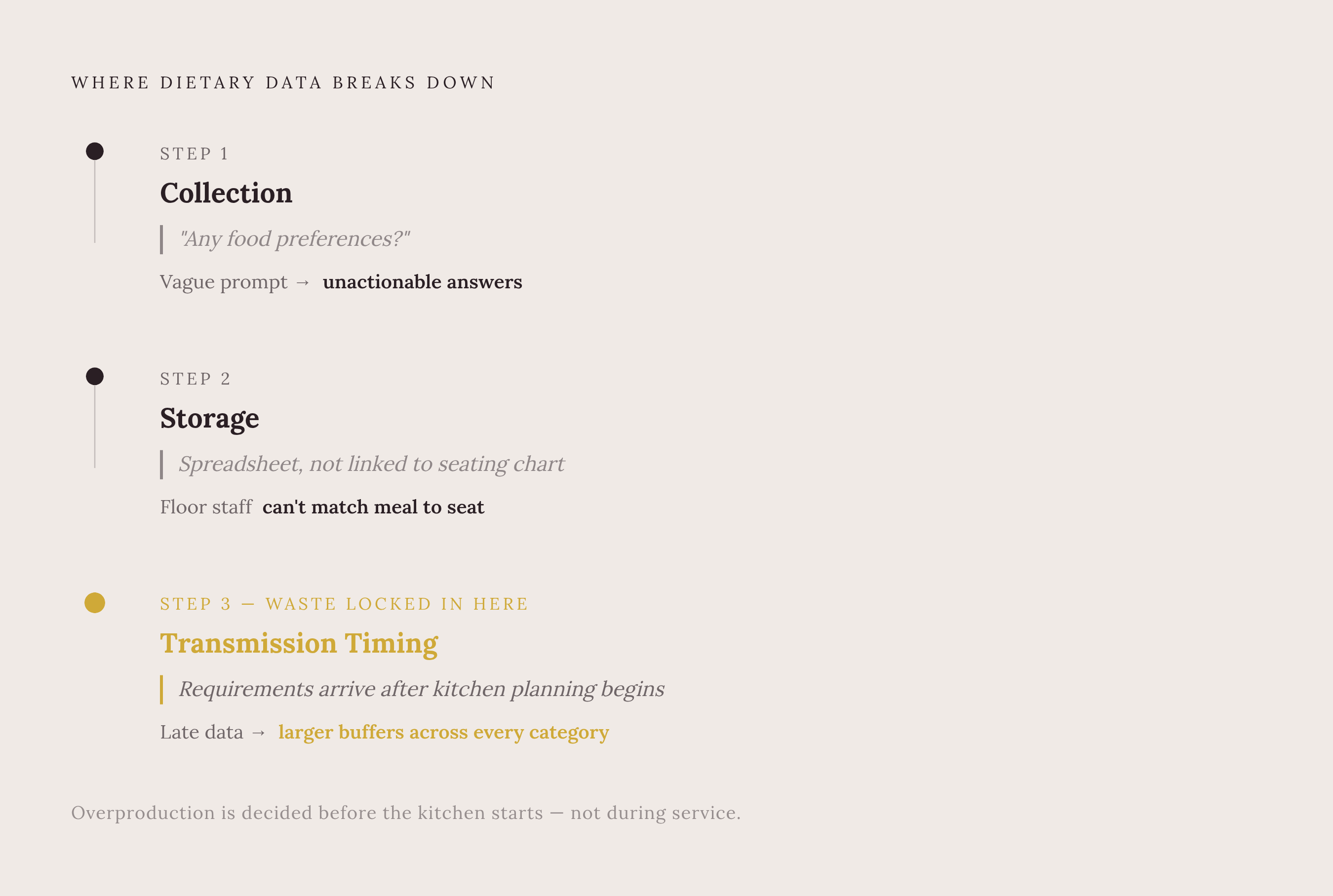
Mismatch doesn't happen randomly. It gets built in at three specific moments in the planning process, and each one is worth examining on its own. The first is collection. Asking guests an open-ended question like "any food preferences?" produces answers a kitchen can't act on. A guest might write "I try to avoid gluten," and that single sentence tells the caterer nothing about whether this is a coeliac-level cross-contamination risk or a loose personal habit. Vague prompts generate vague data, and vague data forces guesswork later.
Storage is the second failure point. Even when a couple collects accurate dietary information, it does no good sitting in a spreadsheet or a buried email thread that's never linked to the seating chart. Floor staff serving a reception have no way to match the right meal to the right seat without that link, and the result is either a wrong meal landing in front of a guest or a correct meal arriving at the wrong table. A second, less obvious version of this failure happens when a guest with no dietary restrictions picks up a specially prepared meal by mistake. The guest who actually needed that meal is left without one, a replacement has to be made, and two meals have now been consumed to feed a single seat.
Transmission timing is the third failure point. The Roo Brothers, a Sydney catering company, put it on their own site: forwarding dietary requirements as soon as they're received "avoids any food wastage for unnecessarily prepared meals, or general confusion regarding overall catering numbers. The flip side of that statement is just as telling. When requirements arrive late, caterers have no choice but to build bigger buffers across every dietary category, because they're planning against uncertainty instead of facts.
Caterers Respond to Information Gaps by Producing More Food
A reasonable question follows from all this: why don't caterers simply wait until they have full information before deciding how much to make? The answer comes down to risk, and it isn't a flaw in how caterers operate. Under-catering a guest with coeliac disease or a severe nut allergy carries consequences, financial, reputational, sometimes legal, that are far more serious than the cost of a few extra meals going unserved. Faced with incomplete or ambiguous dietary data, a caterer's rational move is to prepare more, not less, across every category where the information is unclear. That means the volume of surplus food traces back to how clean the data was when it reached the kitchen. The couple's collection and transmission process, not the caterer's judgment, is what sets the size of that buffer. A smaller, related driver works the same way with desserts and other one-off items: wherever the kitchen is guessing, it hedges by making more.
What the naturally inclusive menu approach actually changes, and what it does not
One of the most sensible fixes practitioners recommend is designing a menu that naturally suits a wide range of guests from the start, built around dishes that happen to be gluten-free, dairy-free, or plant-based without needing to be flagged as "special." This approach genuinely works. It cuts down the number of one-off alternative meals the kitchen has to prepare, which lowers the chances of a wrong-meal-to-wrong-seat error and reduces the category of food most likely to be wasted. A smaller pool of special meals means fewer chances for something to go wrong with any one of them.
What a naturally inclusive menu doesn't do is remove the need for accurate dietary data. Even the most thoughtfully designed inclusive spread won't cover everyone. A guest with a severe nut allergy or a strict halal requirement still needs a specific, clearly flagged meal prepared separately, and that meal still has to reach the correct seat without getting mixed up. The inclusive menu changes the kitchen's starting point. It gives the kitchen less ground to cover with special preparations. Both pieces are needed: a menu that limits exceptions, and a data system that tracks the exceptions that remain.
The strongest objection: guests who do not respond accurately or on time
There's a real limit to how much any of this fixes. Couples can't force guests to answer dietary questions accurately, completely, or on time. Someone will forget to mention a dairy intolerance until the week of the wedding. Someone else will mention a new allergy at the table itself, having developed it after the RSVP window closed. Solotel, in its own guidance to couples, acknowledges this directly: some guests simply forget to disclose requirements, and last-minute changes happen regardless of how well a couple plans. Caterers should be briefed on how to handle unexpected needs and should keep a few versatile backup meals on hand for exactly this reason.
That objection is legitimate, and no RSVP process erases it. But early, structured collection doesn't need to eliminate last-minute surprises to be worth doing: what it does is shrink the number of unknowns the caterer has to plan around. A caterer who knows the precise requirements of the vast majority of guests needs only a small buffer to cover the handful left over. A caterer working from 50 vague or incomplete responses has to build a much larger, much more expensive buffer, because almost half the guest list is a question mark. The risk asymmetry from the previous section still applies: holding a buffer for genuine last-minute medical disclosures is the right call. The buffer should be sized against a small residual group of true unknowns, not against the large, foggy pool that sloppy collection creates.
What Upstream Data Collection Looks Like When It Is Done Well
When dietary data is collected in a structured way, early enough to matter, and linked to the seating chart before the event, the whole failure cascade described earlier gets interrupted before it starts. Named Australian caterers describe what that looks like in practice. Essential Catering points to the seating-plan link as the single most important service-level fix available: dietary notes attached directly to seats let the kitchen prepare meals in the correct sequence and let floor staff deliver them to the right guest without hesitation or confusion. That one connection removes almost all of the wrong-meal-to-wrong-seat error.
The sequence behind that outcome runs in a specific order, and each step depends on the one before it. Requirements get collected through structured RSVP fields rather than open text boxes, so a guest selects "coeliac" or "nut allergy" instead of writing a sentence that needs interpreting. Those responses get compiled against the full guest list, so nothing falls through a gap between a spreadsheet and an email. Each requirement gets linked to a specific seat in the seating chart, so the information travels with the guest. That linked document then gets handed to the caterer with enough lead time to actually shape kitchen planning, not just confirm numbers the night before. Skipping any one of these steps, or handling them in disconnected tools that don't talk to each other, makes the process fail even if every individual step was done carefully. The breakdown happens in the handoff, not in any single task.
How Disconnected Planning Tools Perpetuate the Information Problem
Even couples who fully understand the mismatch and genuinely try to collect dietary data with care will often recreate the same silo failure anyway, simply because they're managing RSVPs in one place, a guest list in another, and a seating chart in a third. The manual transfer between those three separate tools is where errors and omissions sneak in, not in any lack of effort or attention. A name gets mistyped moving from a guest list into a seating chart. A dietary note gets copied into one spreadsheet but never makes it into the version sent to the caterer. None of this requires carelessness. It just requires three disconnected systems and a human being copying data between them by hand.
Digital RSVP tools built with structured dietary fields solve the first half of this problem: they let couples collect, sort, and export dietary information directly to a caterer, which removes both the vague open-text field and the manual retyping step that used to introduce errors between collection and delivery. The more important fix, though, is the connection between that dietary response and the seating chart itself. When a guest's dietary requirement updates automatically in the seating plan the moment it's submitted, the kitchen and the floor staff work from one linked document instead of two separate files that someone has to reconcile by hand later.
The underlying principle holds regardless of which tool a couple chooses: any process that forces someone to re-enter dietary information from one system into another will eventually produce the same transcription errors and omissions that cause mismatch waste. The fix is a system where the data only has to be entered once, and that single entry is what reaches the caterer. End Food Waste Australia's broader research backs the economics of getting this right early: preventing food waste returns several times the investment made to prevent it, with most catering businesses recovering their costs within two years. At the scale of a single wedding, the same logic holds. The cost of setting up dietary data collection properly before the big day is small next to the cost, in wasted meals and strained budgets, of getting it wrong once the kitchen is already cooking.